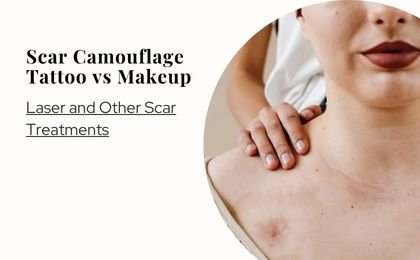
Scar Camouflage Tattoo vs Makeup, Laser and Other Scar Treatments: Which Option Makes Sense?
A scar can remain noticeable for several reasons. Sometimes the main difference is color: the scar may be lighter than the surrounding skin. In other cases, redness, dark pigmentation, thickness, elevation, indentation, or changes in texture are what draw attention to the area.
Because different scar concerns require different solutions, scar camouflage should not automatically be considered the answer for every visible scar.
Micropigmentation scar camouflage is primarily a color-camouflage technique. Customized pigment is tattooed into an appropriate healed scar to reduce its visible contrast with nearby skin. It does not remove the scar, rebuild normal skin, flatten raised tissue, or fill a significant depression.
That distinction is particularly important when comparing scar camouflage tattooing with temporary camouflage makeup, dermatologic treatments, scar revision, lasers, or decorative tattooing.
For clients researching scar camouflage in Los Angeles, our Westwood location is convenient for Beverly Hills, Brentwood, Santa Monica, Century City, Bel Air, Culver City, and nearby communities. The right starting point is determining what makes the scar noticeable and whether tattoo camouflage actually addresses that problem.
What Is Camouflage Tattoo Treatment?
If you are wondering what is camouflage tattoo, it is a tattooing technique intended to make a difference in skin color appear less obvious.
With scar tattoo camouflage, a practitioner selects pigment based on the surrounding skin and introduces that pigment into suitable healed scar tissue.
The intended result is usually subtle. Unlike a decorative tattoo designed to be seen, a skin camouflage tattoo is typically meant to draw less attention to the treated area.
Tattooing and permanent makeup involve introducing pigment into the skin. FDA notes that permanent cosmetic tattooing can also be used in reconstructive settings to simulate natural pigmentation.
The Most Important Question: Is the Problem Color or Texture?
Before comparing treatments, determine why the scar is visible.
When Color Is the Main Concern
A flat, stable scar may be noticeable because it is significantly lighter than nearby skin.
In that situation, cosmetic tattoo for scars may sometimes help reduce the color difference.
When Texture Is the Main Concern
A scar may instead be:
- Raised
- Thick
- Firm
- Depressed
- Pitted
- Contracted
- Uneven
- Attached to deeper tissue
Adding pigment will not correct those structural differences.
When Both Color and Texture Are Different
Some scars have both pigmentation and texture problems.
In these cases, other scar treatments may need to be considered before tattoo scar camouflage. Tattooing the scar first can complicate future treatment planning and may not address the most noticeable feature.
Scar Camouflage Tattoo vs Temporary Scar Makeup
Temporary skin camouflage for scars is one of the easiest alternatives to compare with tattoo camouflage.
Specialized concealers, foundation products, and body camouflage products sit on top of the skin and reduce visible differences temporarily.
Advantages of Temporary Camouflage
Temporary camouflage may be preferable when you want:
- No needles
- No tattooing
- No healing period
- Complete reversibility
- The ability to change color
- Seasonal shade adjustments
- Coverage only for special occasions
- An option while a scar continues maturing
You can also stop using it immediately if the result does not suit you.
Limitations of Temporary Camouflage
Temporary products require repeated application.
They may also:
- Rub onto clothing
- Need reapplication after washing
- Require practice to blend well
- Be affected by sweating
- Require different shades when surrounding skin tans
Advantages of Scar Camouflage Tattooing
A skin camouflage tattoo provides much longer-lasting pigmentation.
It can eliminate the need to recreate the same color camouflage every morning.
Important Trade-Off
Long-lasting does not mean risk-free.
FDA emphasizes that tattoo and permanent-makeup pigment may be difficult to remove completely. Removal can require multiple treatments and can itself result in visible skin changes or scarring.
This makes conservative pigment selection particularly important.
Scar Camouflage Tattoo vs Decorative Tattoo
These are sometimes confused, but their purposes are completely different.
Decorative Camouflage Tattoos
Decorative camouflage tattoos may use artwork to hide, incorporate, or redirect attention away from a scar.
Examples could include floral, geometric, illustrative, or abstract designs.
The scar remains present but becomes part of a larger artistic composition.
Scar Camouflage Tattooing
Scar camouflage tattoos generally use customized skin-related pigments to reduce color contrast.
The desired outcome is often for the area to become less noticeable rather than more decorative.
Which Is Better?
Choose based on your goal.
A decorative tattoo may suit someone who wants visible artwork.
Scar tattoo camouflage may suit someone whose priority is subtle skin-tone blending.
Neither approach changes the physical structure of the scar.
Scar Camouflage vs Laser Scar Treatment
Laser-based scar treatment and micropigmentation scar camouflage serve different purposes.
Laser procedures may sometimes be considered by medical professionals for scar redness, pigmentation, thickness, or texture depending on the scar and the technology used.
Camouflage tattooing introduces color.
That means a scar that is visibly red, dark, raised, or texturally irregular should not automatically receive skin-tone tattoo pigment.
A dermatologist or plastic surgeon may need to address the scar itself before camouflage becomes appropriate.
When Scar Camouflage May Make More Sense
Tattooing may be worth discussing when:
- The scar is fully healed
- It is stable
- Texture is relatively flat
- Color contrast is the main concern
- Medical scar treatment is no longer needed
- Expectations are realistic
When Medical Evaluation May Make More Sense First
Consider medical assessment when the scar is:
- Raised
- Growing
- Painful
- Itchy
- Persistently inflamed
- Very red
- Significantly dark
- Depressed
- Tight
- Restricting movement
- Changing unexpectedly
Scar Camouflage vs Surgical Scar Revision
Surgical scar revision attempts to change the scar structurally.
Depending on the scar, a surgeon may attempt to reposition, reduce, or improve the way the scar heals.
Scar camouflage tattooing services do not surgically change scar tissue.
Therefore, a person unhappy primarily with scar shape or width may need a different solution from someone whose flat scar simply appears too pale.
This is another reason the scar camouflage process should begin with assessment rather than immediate pigment application.
Scar Camouflage vs Microneedling
Microneedling and tattoo camouflage also have different goals.
Microneedling intentionally creates controlled skin injury and may be used by appropriately qualified professionals for selected texture concerns.
Scar camouflage introduces pigment to change visible color.
A client should not assume that one procedure can replace the other.
If texture is the dominant problem, introducing skin-colored tattoo pigment may make little visual difference.
If color contrast is the dominant problem after the scar has stabilized, micropigmentation scar camouflage may be more relevant.
Which Scars Are Better Candidates for Tattoo Camouflage?
The strongest candidates are often scars where color is the primary cosmetic concern.
Examples may include selected:
- Pale surgical scars
- Hypopigmented scars
- Stable trauma scars
- Healed cosmetic-surgery scars
- Healed reconstructive scars
- Hair-transplant scars
- Flat scars with noticeable color contrast
Suitability still depends on individual assessment.
Scar tissue does not behave exactly like unaffected skin, and pigment retention can vary.
Which Scars Need More Caution?
New Scars
A scar may look closed but continue changing for months.
Tattooing too early can mean trying to match tissue that has not reached a stable appearance.
Red or Inflamed Scars
Persistent redness should not simply be neutralized with tattoo pigment without understanding why the scar is red.
Raised Scars
A raised scar is a structural issue.
Tattooing does not flatten it.
Keloids
Keloids require particular caution because tattooing itself creates additional skin injury. The American Academy of Dermatology advises people prone to keloids to avoid unnecessary skin trauma, including tattoos, because another keloid can develop after injury.
Dark Scars
A hyperpigmented scar is already darker than its surroundings.
Adding lighter tattoo pigment does not necessarily provide predictable lightening and may make future management more difficult.
Open or Infected Scars
These should never be treated as routine cosmetic tattoo candidates.
Why Skin-Tone Matching Is More Complex Than It Looks
There is no universal “skin-colored” pigment.
Natural skin contains combinations of:
- Red
- Yellow
- Brown
- Olive
- Pink
- Golden
- Neutral
- Cool undertones
The same client may also have different colors on different areas of the body.
Sun exposure adds another challenge.
Natural skin can tan because melanin production changes. Tattoo pigment does not tan in exactly the same way.
This means a skin camouflage tattoo that blends closely with winter skin may become somewhat more visible when surrounding skin becomes significantly darker in summer.
A responsible consultation should discuss this before tattooing.
The Scar Camouflage Process
Step 1: Evaluate the Scar
The practitioner examines:
- Scar age
- Healing status
- Color
- Texture
- Thickness
- Location
- Previous procedures
- Previous pigmentation
- Skin type
- Keloid history
- Medical conditions affecting healing
Step 2: Determine Whether Tattooing Addresses the Real Problem
If texture, thickness, inflammation, or instability is the main concern, tattooing may not be the appropriate first treatment.
Step 3: Analyze Surrounding Skin
Pigment selection is based on more than surface color.
Undertone and natural variation need to be considered.
Step 4: Choose Pigment Conservatively
Overcorrecting a scar during the first session can create a visible tattoo rather than subtle camouflage.
A staged approach provides greater control.
Step 5: Perform Micropigmentation
Pigment is deposited into suitable scar tissue through controlled needle application.
In Los Angeles County, micropigmentation falls within permanent cosmetics/body art. Practitioners are required to register with the County, while body-art businesses under County jurisdiction require a Public Health permit or license.
Step 6: Allow Complete Healing
Fresh pigmentation may temporarily appear darker.
Redness and swelling can also distort color perception.
Step 7: Evaluate Pigment Retention
Some scar areas may retain pigment differently from others.
The practitioner should assess the healed color rather than assuming that every section requires additional tattooing.
Step 8: Refine Where Needed
Additional treatment may improve:
- Color balance
- Lighter healed sections
- Undertone mismatch
- Transition into surrounding skin
Why Scar Camouflage Should Be Built Gradually
Scar tissue is less predictable than normal skin.
A conservative first treatment has several advantages:
- Reduces the risk of over-darkening
- Allows healing response to be assessed
- Shows how pigment settles
- Makes undertone correction easier
- Preserves more options for refinement
Because unwanted tattoo pigment can be difficult to remove, adding too little initially is generally easier to address than adding too much.
FDA specifically warns that permanent makeup and tattoo pigment can be challenging to remove and that dissatisfaction is a recognized problem.
What Results Should You Expect?
Successful tattoo scar camouflage should generally make a suitable scar less noticeable because its color contrasts less strongly with surrounding skin.
The scar itself is still there.
Realistic outcomes may include:
- Reduced pale appearance
- Softer transition into nearby skin
- Less obvious color contrast
- More visually even skin tone
It should not be described as:
- Scar removal
- Perfect skin restoration
- Texture correction
- Guaranteed invisible coverage
- Permanent exact color matching
The more realistic the expectations, the easier it is to evaluate whether treatment was successful.
What Should Before-and-After Photos Show?
When comparing scar camouflage tattooing services, look for healed results.
Good photographs should have:
- Similar lighting
- Similar camera angle
- Similar distance
- No heavy filters
- Clear visibility of scar texture
- Skin tones similar to yours
- Scars similar to yours
- Long-enough healing time to judge color
A fresh tattoo may appear impressively saturated but tells you very little about long-term pigment integration.
Healing After Scar Camouflage Tattooing
Immediately after treatment, the area may be:
- Red
- Slightly swollen
- Sensitive
- Temporarily darker
- More noticeable than before
That does not mean the treatment failed.
The color must settle before the result can be assessed.
During healing, avoid picking or scratching because unnecessary trauma can interfere with the skin’s recovery.
Scar Camouflage Aftercare
Your practitioner’s written instructions should always be followed.
General care may include:
- Keep the area clean as instructed
- Wash your hands before touching it
- Avoid scratching
- Do not peel flakes or crusting
- Avoid friction
- Avoid swimming during early healing
- Avoid hot tubs
- Avoid prolonged soaking
- Limit heavy sweating as directed
- Avoid sauna and steam
- Avoid harsh skincare over the fresh tattoo
- Protect healed skin from excessive UV exposure
Because tattoo needles penetrate the skin, sanitation matters. Los Angeles County identifies local infection, infectious-disease transmission, and bloodborne pathogens among the main public-health concerns associated with body art.
Risks of Scar Camouflage Tattooing
Cosmetic tattoo for scars involves the same broad category of risks associated with tattooing.
These can include:
- Infection
- Allergic reaction
- Granulomas
- Swelling
- Burning or irritation
- Additional scarring
- Keloid formation
- Pigment migration
- Uneven color
- Fading
- Difficulty with removal
FDA also notes that infections can occur because of microbial contamination in tattoo ink, even when equipment hygiene is otherwise appropriate.
Seek medical care if you develop worsening redness, increasing pain, significant swelling, drainage, fever, or another concerning reaction.
Scar Camouflage and Keloid-Prone Skin
This deserves particular emphasis.
A tattoo creates thousands of tiny skin injuries.
For most appropriately selected clients, these heal normally. But a person with a strong tendency to form keloids has a different risk profile.
The AAD notes that tattoos can trigger keloids in susceptible individuals and advises people who are prone to this type of scar to avoid unnecessary skin injuries where possible.
A personal or family history of keloids should therefore be discussed before considering scar camouflage tattoos.
How Long Does Scar Camouflage Last?
A camouflage tattoo is intended to be long-lasting, but its visible appearance may not stay identical indefinitely.
Factors affecting appearance can include:
- Scar tissue
- Pigment characteristics
- Treatment depth
- Sun exposure
- Body location
- Skin changes
- Individual healing
- Lifestyle
A future touch-up may be desirable if the pigment gradually softens.
Color maintenance should be based on the healed appearance rather than performed automatically on a fixed schedule.
Can Scar Camouflage Be Removed?
Tattoo removal is possible in some situations but should never be treated as an easy backup plan.
FDA explains that removal may require multiple treatments, can be expensive, may fail to remove all pigment, and can potentially leave scarring or discoloration.
Skin-colored pigments can also complicate corrective treatment.
This is why conservative pigment selection and careful practitioner choice matter from the beginning.
Common Scar Problems and the Better Starting Point
“My Scar Is Flat but Much Whiter Than My Skin”
This may be a stronger situation for considering micropigmentation scar camouflage.
Solution: assess scar stability, undertone, and how surrounding skin changes with sun exposure.
“My Scar Is Very Raised”
Pigment will not flatten it.
Solution: obtain medical scar evaluation before deciding whether cosmetic tattooing has any later role.
“My Scar Is Still Bright Red”
Do not immediately attempt to cover the redness.
Solution: determine whether the scar is still maturing or whether another scar treatment is appropriate.
“My Scar Is Darker Than My Skin”
Adding skin-tone pigment may not be the best first approach.
Solution: seek professional evaluation to determine whether pigmentation treatment should be addressed differently.
“I Want Something I Can Change Later”
Permanent tattooing may not suit that priority.
Solution: consider temporary skin camouflage for scars before committing to pigment implantation.
“I Don’t Want to Apply Makeup Every Day”
For an appropriate, stable scar, a skin camouflage tattoo may offer a longer-lasting alternative.
Solution: begin with scar assessment and realistic color-matching expectations.
“My Scar Has Both Texture and Color Problems”
Camouflage only addresses part of the concern.
Solution: discuss structural scar treatment first and tattoo camouflage later if residual color difference remains.
How to Choose Scar Camouflage in Los Angeles
When comparing scar camouflage in Los Angeles, avoid choosing solely by price or heavily edited before-and-after photos.
Ask:
- Is my scar fully healed and stable?
- What specific feature will tattooing improve?
- Will it change texture?
- Is my scar suitable for pigment?
- Can I see healed work?
- Have you treated scars similar to mine?
- How do you match skin undertones?
- How many sessions may be needed?
- What happens if pigment heals unevenly?
- What are the risks for my skin?
- What is your touch-up policy?
- Is the practitioner registered?
- Is the facility properly permitted?
- What infection-control procedures are followed?
Los Angeles County requires body-art practitioner registration and applicable facility permitting for body-art businesses within its jurisdiction.
Our Westwood location provides convenient access for clients from Beverly Hills and Century City as well as Brentwood, Santa Monica, Bel Air, Culver City, and surrounding Los Angeles neighborhoods.
Frequently Asked Questions
What Is Camouflage Tattoo?
A camouflage tattoo uses implanted pigment to reduce visible color differences between an appropriate area of skin and its surroundings. With scar treatment, the goal is usually subtle blending rather than decorative artwork.
What Is Micropigmentation Scar Camouflage?
Micropigmentation scar camouflage involves placing customized pigment into suitable healed scar tissue to make its color more compatible with surrounding skin.
Is Scar Camouflage Better Than Makeup?
It depends on your priorities. Temporary skin camouflage for scars is reversible and easy to adjust, while tattoo camouflage provides a longer-lasting result but requires healing and is harder to reverse.
Is Scar Camouflage Better Than Laser Treatment?
They address different concerns. Scar camouflage tattooing mainly addresses color contrast. Medical laser procedures may target other scar characteristics depending on the scar and treatment used. A professional assessment can determine which concern should be addressed first.
Can a Cosmetic Tattoo for Scars Remove the Scar?
No. A cosmetic tattoo for scars does not remove scar tissue. It may reduce visible color contrast in appropriate scars but does not eliminate texture, thickness, or indentation.
Can Scar Camouflage Tattooing Be Used on a Keloid?
Keloid-prone skin requires substantial caution. Tattooing is itself a skin injury and can trigger keloid formation in susceptible people. Medical assessment is appropriate before considering tattooing.
How Many Scar Camouflage Sessions Are Needed?
The number varies according to scar size, pigment retention, skin tone, location, scar tissue, and desired blending. A staged approach allows healed pigment to guide later treatment.
Is a Skin Camouflage Tattoo Permanent?
A skin camouflage tattoo is long-lasting because pigment is implanted into the skin, although visible color may fade or change and future touch-ups can be needed.
Can Tattoo Scar Camouflage Change Scar Texture?
No. Tattoo scar camouflage does not flatten raised scars or fill depressed tissue. If texture is the main concern, medical scar assessment may be more appropriate before tattooing.
Where Can I Book Scar Camouflage in Los Angeles?
Our Westwood location provides convenient access for clients seeking scar camouflage in Los Angeles from Beverly Hills, Brentwood, Santa Monica, Century City, Bel Air, Culver City, and nearby neighborhoods. Before treatment, the scar should be assessed for stability, texture, color, and suitability for cosmetic pigmentation.
Choose the Treatment Based on What Makes Your Scar Noticeable
The best solution depends on the scar itself. Temporary camouflage offers flexibility, medical treatments may address structural or active scar concerns, decorative tattoos create artwork, and scar camouflage tattooing can help suitable healed scars blend more closely with surrounding skin when color contrast is the main issue.
Book your Westwood consultation to discuss your scar, skin tone, the scar camouflage process, pigment-matching possibilities, expected results, healing, aftercare, and whether micropigmentation is the right approach for you.
Book Your Free Consultation
Get expert advice and a personalized treatment plan—no commitment required