
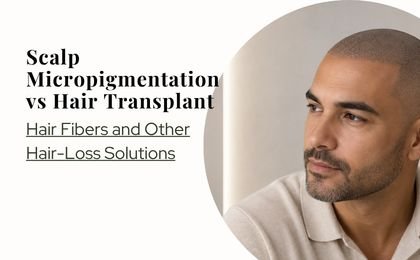
Scalp Micropigmentation vs Other Hair-Loss Solutions: Which Is Right for You?
Hair loss does not have a single solution because people experience it differently. A man with an advanced receding hairline who keeps his head closely shaved has different goals from someone with moderate crown thinning, while a person with a visible hair-transplant scar may mainly want camouflage rather than additional hair growth.
Scalp micropigmentation, commonly called SMP, is one option for changing the visual appearance of thinning or bald areas. Unlike hair transplantation, it does not relocate follicles. Unlike hair fibers or scalp concealers, it does not wash away after everyday use. Instead, specialized pigment impressions are placed in the scalp to resemble closely cropped follicles or reduce the contrast between existing hair and visible skin. Research describes SMP as tattoo-based camouflage that can be used for several patterns of alopecia and selected scalp scars.
Understanding what each hair-loss option can actually accomplish makes it easier to decide whether hair scalp micropigmentation, surgery, temporary concealers, or another treatment fits your goals.
For people researching scalp micropigmentation in Los Angeles, a Westwood consultation provides an opportunity to compare these options based on your current hair, scalp condition, desired hairstyle, future hair-loss pattern, maintenance preferences, and budget. Our location is convenient for Beverly Hills, Brentwood, Santa Monica, Century City, Bel Air, Culver City, and surrounding Los Angeles neighborhoods.
What Is Scalp Micropigmentation?
If you are asking what is scalp micropigmentation, SMP is a specialized form of cosmetic tattooing used to create visual scalp camouflage.
Pigment is placed in carefully controlled dots across selected areas. On a closely shaved scalp, these impressions are designed to resemble very short hair follicles. When natural hair remains, scalp pigmentation can be distributed between hairs to reduce the contrast created by visible scalp. Research has documented SMP use for male-pattern hair loss, female-pattern hair loss, alopecia, and selected scalp scars.
SMP does not:
- Grow new hair
- Increase actual follicle density
- Stop progressive hair loss
- Treat hormonal causes of hair loss
- Replace medical diagnosis
- Create physical strands of hair
It is primarily a cosmetic camouflage technique.
How Does Scalp Micropigmentation Work?
The scalp micropigmentation process involves depositing pigment through repeated controlled needle placements.
The practitioner adjusts dot size, pigment tone, spacing, distribution, and density according to the surrounding natural follicles and intended result. Recent clinical work emphasizes gradual pigment layering, varied placement, and controlled treatment depth as important elements of natural-looking SMP.
A typical plan may involve multiple sessions rather than attempting full coverage immediately. One published study used three SMP sessions plus a subsequent touch-up, while a 2025 clinical series also used a staged three-session protocol. These examples demonstrate why SMP is commonly built progressively, although individual treatment schedules vary.
The benefit of this approach is that the practitioner can evaluate healed pigment before increasing density.
Scalp Micropigmentation vs Hair Transplant
Hair transplantation and SMP are frequently compared, but they provide fundamentally different results.
Hair Transplantation Creates Actual Hair
A hair transplant moves follicles from donor areas to areas affected by hair loss. When those grafts survive, they can produce actual growing hairs.
Because it involves surgery and available donor follicles, candidacy depends on factors such as the pattern of hair loss, donor supply, scalp characteristics, and desired coverage.
Scalp Micropigmentation Creates an Illusion of Density
SMP does not move follicles. Instead, the micropigmentation of the scalp changes the appearance of the skin beneath and around the hair.
A 2024 retrospective study comparing SMP and transplantation in women with pattern hair loss found that pre-existing hair density was an important consideration when selecting between the two approaches. The findings reinforce a practical principle: SMP and transplantation suit different hair-density situations rather than being interchangeable procedures.
SMP May Be More Attractive When:
- You prefer a closely shaved appearance
- You have limited interest in surgery
- Your goal is visual camouflage
- Remaining hair creates visible scalp contrast
- A hair-transplant scar needs camouflage
- Previous transplantation still left visible scalp
- Donor-hair limitations affect transplant options
Hair Transplant May Be More Attractive When:
- Growing physical hair is the main goal
- You want the ability to style actual strands
- You have suitable donor hair
- Surgery is acceptable
- The hair-loss pattern is appropriate for transplantation
The right decision should therefore be based on what you want the finished scalp to look like—not simply which treatment is marketed more aggressively.
Can Scalp Micropigmentation and Hair Transplant Be Combined?
Yes, the two approaches can sometimes complement each other.
Published SMP studies include patients who used micropigmentation after or alongside previous hair-transplant procedures. SMP has also been used to camouflage donor scars and reduce visible scalp between transplanted hairs.
For example, a client may have:
- Adequate transplanted hair but remaining scalp visibility
- A linear donor scar
- FUE extraction marks
- Uneven visual density
- Areas where additional transplantation is not desired
In these cases, SMP can provide camouflage without claiming to increase the number of hairs.
Timing matters. Recently transplanted areas or scars must heal adequately before additional tattoo-based treatment is considered.
Scalp Micropigmentation vs Hair Fibers
Hair fibers are temporary cosmetic products that attach to existing hairs and visually increase fullness.
Advantages of Hair Fibers
They are:
- Non-invasive
- Quickly applied
- Easy to discontinue
- Useful for special events
- Relatively flexible if your hairstyle changes
Limitations of Hair Fibers
They generally need repeated application and depend on enough existing hair for the fibers to attach effectively.
Sweating, washing, touching, or environmental conditions may also affect temporary camouflage products.
Advantages of SMP
SMP offers much longer-lasting scalp pigmentation because pigment is inserted into the skin.
You do not need to recreate the same camouflage every morning.
However, longevity is also a commitment. FDA guidance emphasizes that tattoos and permanent cosmetics can be difficult to remove completely, and removal may require repeated laser procedures with risks such as scarring or incomplete pigment clearance.
For someone uncertain about a new hairline position, temporary fibers may offer more flexibility. For someone committed to a closely shaved look or long-term scalp camouflage, SMP may provide greater convenience.
Scalp Micropigmentation vs Scalp Concealer Sprays and Powders
Scalp sprays and powders darken exposed skin temporarily.
They can provide quick coverage for thinning areas but must usually be reapplied following washing.
Hair scalp micropigmentation achieves a similar broad goal—reducing scalp contrast—but through tattooed pigment rather than removable cosmetics. Research on hair camouflage identifies SMP as one option for creating a more lasting visual illusion of hair density.
The tradeoff is commitment.
Temporary concealer can be washed away immediately if the color or design is unsuitable. Poor SMP can be considerably harder to revise.
A 2024 study of patients seeking correction for unsatisfactory SMP documented revision approaches including repeat SMP, laser tattoo removal, hair transplantation, and combined procedures. This illustrates why selecting an experienced practitioner and conservative design from the beginning matters.
Scalp Micropigmentation for Men vs Hair Replacement Systems
Hair systems physically add artificial or donated hair attached to the scalp or remaining hair.
They can create actual hair length and styling options that SMP cannot.
However, hair systems require ongoing cleaning, attachment, maintenance, and replacement.
Scalp micropigmentation for men may appeal more to someone comfortable with a buzzed or shaved appearance who does not need actual strands.
A hair system may be more suitable if the person wants:
- Longer hair
- Styling versatility
- Physical volume
- Immediate coverage without tattooing
SMP may suit someone who wants:
- A shaved-follicle effect
- Reduced scalp contrast
- No attached hairpiece
- Lower daily camouflage effort
- A visually reconstructed hairline
Neither approach is automatically better.
Scalp Micropigmentation vs Medical Hair-Loss Treatment
SMP and medical hair-loss treatment have different purposes.
SMP camouflages appearance. It does not address the biological process causing hair loss.
Anyone experiencing rapid, unexplained, inflamed, painful, or patchy hair loss should consider dermatologic evaluation before cosmetic camouflage.
A person may sometimes use SMP while also receiving medically appropriate treatment for hair loss, but this should be coordinated carefully around healing and scalp procedures.
Which Option Is Best for a Receding Hairline?
For men who already prefer very short hair, scalp micropigmentation for men can visually rebuild the transition between the forehead and existing follicles.
The key factor is hairline design.
The result should complement:
- Facial proportions
- Age
- Temple shape
- Existing hair
- Future hair-loss risk
- Skin tone
Hair transplantation may be preferable when actual hair growth along the frontal hairline is the priority and suitable donor follicles are available.
Temporary hair fibers usually offer less benefit at a completely bare frontal hairline because they depend on existing hair for visual integration.
Which Option Is Best for Crown Thinning?
Crown thinning often retains enough natural hair for several options.
SMP can darken the visual background between remaining hairs, creating an impression of greater density without creating new follicles.
Hair fibers can also be effective when enough hair remains for adhesion.
Hair transplantation may be considered when actual crown hair restoration is desired and surgical factors are favorable.
The best scalp micropigmentation strategy for crown thinning should also anticipate future hair loss. If natural hair continues disappearing around a treated area, new visible scalp may eventually require additional camouflage.
Which Option Is Best for Scalp Scars?
SMP can be useful for selected scalp scars where the contrast between a pale or visible scar and surrounding hair makes it noticeable.
Research has documented scalp micropigmentation for postoperative and other scalp scars, including scars related to hair restoration surgery.
Scar tissue behaves differently from normal scalp skin, so pigment retention can be less predictable.
A 2025 SMP case series found greater fading in patients with scarring alopecia than in androgenetic alopecia during six-month follow-up.
Scar camouflage should therefore be approached conservatively, with realistic expectations about additional sessions or future maintenance.
Benefits of Scalp Micropigmentation
The main benefits of scalp micropigmentation include:
- No requirement to grow new hair
- Visual reconstruction of selected hairlines
- Reduced contrast between scalp and existing hair
- A realistic closely shaved effect when executed well
- Camouflage for selected scars
- Application across different patterns of alopecia
- Potential use alongside previous hair transplantation
- Less daily camouflage than removable scalp cosmetics
Published clinical studies have reported high patient satisfaction in selected SMP groups. However, studies have generally involved relatively small numbers of patients, and recent research still notes limited standardized long-term data.
Before and After Scalp Micropigmentation: What Results Should You Expect?
Scalp micropigmentation before and after photographs can help you evaluate whether a practitioner consistently creates believable results.
But same-day photographs can be misleading.
Immediately after treatment, redness and fresh pigment can make the result appear darker and sharper than it will after healing.
When looking at scalp micropigmentation before after photos, prioritize:
- Healed examples
- Consistent lighting
- Matching camera angles
- Similar hair length
- Close-up views
- Crown photos
- Temple transitions
- Results on similar skin tones
- Examples of similar hair-loss patterns
For scalp micropigmentation before after images involving scars, ask how long after treatment the final photograph was taken.
You should also evaluate whether individual impressions remain distinct rather than merging into a solid area.
What Can Go Wrong With SMP?
Poorly planned or poorly executed SMP may produce:
- Hairlines that are too dark
- Excessively straight edges
- Oversized impressions
- Pigment spreading or blurring
- Uneven density
- Unwanted color changes
- Poor scar blending
- An unnatural transition to remaining hair
- Difficulty adapting to future hair loss
Research specifically examining unsatisfactory SMP outcomes confirms that correction can require laser removal, repeat SMP, transplantation, or combinations of procedures.
The safest strategy is therefore to begin conservatively.
Is Scalp Micropigmentation Permanent?
Is scalp micropigmentation permanent? SMP should be treated as a long-lasting cosmetic tattoo.
Los Angeles County defines micropigmentation as permanent cosmetics because pigment is inserted into human skin tissue to alter appearance.
However, “permanent” does not mean the appearance will remain identical forever.
Pigment can fade, and surrounding natural hair may continue changing.
A 2025 case series documented some reduction in visual density at six months, with greater fading in scarring alopecia cases. Researchers also emphasized the need for more long-term pigment-retention studies.
How Long Does Scalp Micropigmentation Last?
There is no universal answer to how long does scalp micropigmentation last.
Longevity is influenced by:
- Pigment characteristics
- Placement technique
- Treatment depth
- Skin type
- UV exposure
- Scalp-care routine
- Lifestyle
- Natural fading
- Future hair loss
- Scar tissue when treated
One earlier study followed SMP patients for 7–32 months and reported minimal fading overall, while newer research emphasizes that longer standardized follow-up remains limited.
A responsible practitioner should therefore discuss maintenance instead of promising an exact lifespan.
Scalp Micropigmentation Aftercare
Appropriate scalp micropigmentation aftercare is important because tattooing breaks the skin barrier.
During initial healing, the scalp should be cared for according to the practitioner’s written instructions.
General considerations may include:
- Avoid scratching
- Avoid picking flakes
- Keep the scalp appropriately clean
- Avoid prolonged soaking during early healing
- Delay swimming
- Limit heavy sweating when instructed
- Avoid sauna and steam
- Avoid unnecessary friction
- Protect the scalp from excessive sun
- Follow instructions regarding shaving
- Avoid unapproved products on fresh treatment
Tattooing carries risks of infection, allergic reactions, granulomas, keloids, swelling, scarring, and complications related to pigment. FDA also warns that contaminated ink can cause infection even when hygienic technique is otherwise followed.
Contact a healthcare professional for progressively worsening pain, redness, swelling, drainage, fever, or another concerning reaction.
Scalp Micropigmentation Cost vs Other Options
Scalp micropigmentation cost depends on the size and complexity of treatment rather than one fixed rate.
Your micropigmentation price may depend on:
- Hairline-only treatment
- Crown coverage
- Full top-of-scalp coverage
- Density work
- Scar camouflage
- Number of sessions
- Previous SMP correction
- Required touch-ups
When comparing SMP with other approaches, consider long-term cost rather than only the initial appointment.
Hair fibers and concealers require repeated purchases. Hair systems require ongoing maintenance and replacement. Hair transplantation has surgical and follow-up costs. SMP may eventually require pigment maintenance.
The cheapest initial solution is therefore not automatically the least expensive over time.
Choosing the Best Scalp Micropigmentation in Los Angeles
Finding the best scalp micropigmentation Los Angeles provider should involve more than comparing price or social-media followers.
Los Angeles County currently classifies micropigmentation as body art/permanent cosmetics. Body-art practitioners must register with the County, and facilities operating in Los Angeles County generally require the appropriate Public Health permit or license. The County’s regulatory framework focuses heavily on infection prevention and cross-contamination control.
Before booking scalp micropigmentation Los Angeles treatment, ask:
- Is the practitioner registered?
- Is the facility properly permitted?
- Can I see healed results?
- Do you have examples of my hair-loss pattern?
- How will you design my hairline?
- What happens if my natural hair continues thinning?
- How many sessions are expected?
- What is included in the micropigmentation price?
- How are needles and pigment handled?
- What is your correction policy?
- What aftercare will I receive?
Clients from Beverly Hills, Brentwood, Santa Monica, Century City, Bel Air, Culver City, and nearby neighborhoods can use a Westwood consultation to compare SMP with transplantation, temporary camouflage, or other options before committing.
Frequently Asked Questions
What Is Scalp Micropigmentation?
Scalp micropigmentation is cosmetic tattoo-based camouflage that uses pigment impressions to resemble closely shaved follicles or reduce visible scalp contrast. It does not grow hair.
How Does Scalp Micropigmentation Work?
Pigment is deposited through controlled needle placements across selected scalp areas. The practitioner adjusts color, spacing, dot size, and density to create a follicle-like appearance.
Is SMP Better Than a Hair Transplant?
Neither is universally better. SMP provides visual camouflage, while transplantation relocates actual follicles. Your desired hairstyle, donor supply, degree of hair loss, willingness to undergo surgery, and expectations influence the choice.
What Are the Benefits of Scalp Micropigmentation for Men?
Scalp micropigmentation for men can visually rebuild a receding hairline, create a shaved-follicle appearance, reduce crown scalp visibility, and camouflage selected scars.
Is Scalp Micropigmentation Permanent?
SMP is a long-lasting cosmetic tattoo, but fading and changes in appearance occur over time. Maintenance may eventually be required.
How Long Does Scalp Micropigmentation Last?
There is no guaranteed lifespan. Longevity varies with technique, pigment, skin, UV exposure, scalp care, scar tissue, and natural hair-loss progression.
Can SMP Be Used After a Hair Transplant?
Yes, selected clients use SMP to reduce remaining scalp visibility or camouflage donor scars after transplantation. Adequate healing is required before treatment.
What Should I Look for in Scalp Micropigmentation Before and After Photos?
Look for healed scalp micropigmentation before and after results, consistent lighting, close-up hairlines, crown views, natural transitions, and examples matching your skin tone and hair-loss pattern.
How Much Does Scalp Micropigmentation Cost?
Scalp micropigmentation cost depends on treatment area, number of sessions, density, scar work, hairline complexity, and correction needs. A consultation is necessary for a personalized micropigmentation price.
Where Can I Get Scalp Micropigmentation in Los Angeles?
A Westwood consultation is convenient for clients from Beverly Hills, Brentwood, Santa Monica, Century City, Bel Air, Culver City, and nearby areas. When comparing scalp micropigmentation in Los Angeles, verify practitioner registration, facility permitting, healed results, hygiene practices, and long-term treatment planning.
Choose the Hair-Loss Solution That Matches Your Goal
The best scalp micropigmentation choice depends on what you actually want to achieve. SMP can create long-lasting visual camouflage, hair transplantation can provide real transplanted follicles, and temporary fibers or concealers can offer reversible coverage.
Book a personalized Westwood consultation to compare scalp micropigmentation with other hair-loss options and discuss your hairline, crown, existing density, scalp micropigmentation results, aftercare, maintenance, and personalized cost.
Book Your Free Consultation
Get expert advice and a personalized treatment plan—no commitment required