
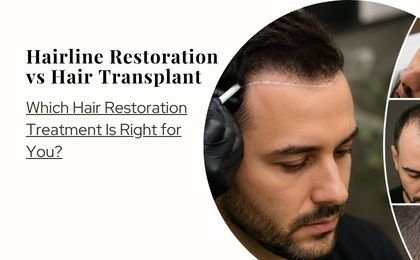
Hairline Restoration vs Hair Transplant: Which Option Is Right for You?
A receding hairline is often one of the first noticeable signs of hair loss. The temples may gradually move backward, the frontal hairline may become thinner, or the forehead can appear larger as density decreases. Once this happens, many people begin researching hairline restoration, but quickly discover that the term covers very different treatments.
One option is surgical hair transplantation, which moves existing follicles from donor areas into thinning or bald regions. Another is cosmetic hairline restoration with scalp micropigmentation, or SMP, which uses carefully placed pigment impressions to simulate the appearance of very short follicles. The two procedures can create very different outcomes and should not be treated as interchangeable solutions.
For people considering hairline restoration in Los Angeles, understanding those differences is essential before choosing a provider. Someone who wants real, growing hair may have completely different needs from someone who prefers a closely shaved hairstyle and simply wants a stronger-looking hairline.
Our Westwood location provides convenient access for clients from Beverly Hills, Brentwood, Santa Monica, Century City, Bel Air, Culver City, and surrounding Los Angeles neighborhoods who want to explore cosmetic hairline restoration with a personalized approach.
What Is Hair Restoration?
One of the most common questions is what is hair restoration?
Hair restoration is a broad term covering procedures and treatments intended to improve hair coverage or the visual appearance of areas affected by hair loss.
It can include:
- Surgical hair transplantation
- Medical treatment for diagnosed forms of hair loss
- Cosmetic scalp micropigmentation
- Temporary hair fibers or concealers
- Hair replacement systems
- Combinations of these approaches
Hair transplantation works by relocating existing hair-bearing grafts or follicles from donor areas to thinning or bald areas. According to the American Society of Plastic Surgeons, successful transplantation depends partly on having adequate healthy donor hair, typically at the back and sides of the scalp.
Cosmetic hair restoration treatment with SMP works differently. It does not move or produce follicles. Instead, pigment is applied within the skin to create the visual impression of closely cropped follicles or reduce the contrast between hair and scalp.
This means the first step in choosing a treatment is defining what “restoration” means to you.
Cosmetic Hairline Restoration With Scalp Micropigmentation
For a receding hairline, scalp micropigmentation can be used to visually extend follicle-like detail into areas where natural hair has become sparse or disappeared.
The treatment is particularly suited to clients who wear their hair short because the pigment impressions can visually integrate with closely clipped natural follicles.
A customized design may address:
- Frontal recession
- M-shaped hairlines
- Receding temples
- Uneven hairlines
- Visible scalp behind the frontal hairline
- Selected transplant scars
- Previous SMP requiring refinement
Because SMP involves inserting pigment into skin, Los Angeles County treats micropigmentation as permanent cosmetics/body art. Practitioners are required to register with the County, and body-art facilities operating within Los Angeles County generally require a Public Health Permit/License, except in jurisdictions with their own environmental-health authority.
How Does a Hairline Restoration Procedure Work?
A cosmetic hair restoration procedure should begin with design rather than pigmentation.
1. Hairline Assessment
The practitioner evaluates your current frontal hairline, temples, existing density, hairstyle, scalp tone, previous treatments, scars, and overall pattern of recession.
Future hair loss should also be considered. SMP does not stop biological hair loss, so designing an extremely low hairline without considering future recession can create difficulties later.
2. Hairline Mapping
The proposed new hairline is mapped across the forehead and temples.
The ideal position depends on:
- Facial proportions
- Forehead height
- Age
- Existing hair
- Temple structure
- Degree of recession
- Hairstyle
- Desired level of definition
A personalized design usually creates a more convincing result than applying the same template to every person.
3. Pigment Selection
Pigment is selected to coordinate visually with the scalp and existing follicles.
The goal is not simply to make the area dark. A successful result depends on creating believable contrast and density.
4. First Pigmentation Session
The practitioner begins establishing follicle-like impressions throughout the planned areas.
Starting conservatively allows the healed pigment to be evaluated before additional density is added.
5. Healing
Fresh pigmentation may appear darker and more defined immediately after treatment. Mild redness and skin sensitivity can also temporarily affect how the result looks.
6. Additional Density and Refinement
Subsequent sessions can improve:
- Hairline density
- Temple transitions
- Blending
- Symmetry
- Lighter healed areas
- Connection to existing follicles
This gradual approach provides more control over the final appearance.
How Does a Hair Transplant Work?
Surgical transplantation is fundamentally different.
Hair-bearing grafts or individual follicles are removed from donor areas and transferred to areas where hair is thinning or absent. The objective is to create actual hair growth using the patient’s existing follicles.
The success and potential coverage depend partly on donor-hair availability. Hair characteristics such as texture and color can also influence the cosmetic outcome.
A transplant therefore provides something SMP cannot: real hair strands.
However, surgery also introduces considerations that SMP does not, including graft survival, surgical healing, bleeding, infection, scarring, and the possibility that surrounding natural hair may continue thinning after surgery.
Hairline Restoration vs Hair Transplant: Main Differences
SMP Hairline Restoration
Cosmetic SMP:
- Creates an illusion of short follicles
- Does not grow hair
- Does not require donor follicles
- Works especially well with short or shaved hairstyles
- Can visually redefine temples and frontal recession
- Can camouflage selected scars
- Requires tattoo-based pigmentation
- May fade and require maintenance
- Can be difficult to reverse completely
Hair Transplant
Surgical transplantation:
- Relocates actual follicles
- Can produce growing hair
- Requires usable donor hair
- Allows physical hair length and styling
- Requires surgery
- Has a surgical recovery period
- Can produce scars
- May require additional treatment if natural hair loss progresses
The best hairline restoration option therefore depends less on which procedure is “better” and more on the result you want.
Which Is Better for a Receding Hairline?
For someone with a receding hairline who prefers a buzz cut or shaved style, SMP can offer an effective cosmetic approach because the objective is to imitate the appearance of very short follicles.
For someone who wants actual hair that can grow several inches and be styled, transplantation is more aligned with that goal.
A client should not choose SMP expecting long hair, and should not automatically undergo surgery when the desired look is simply a clean, closely shaved hairline.
Which Is Better for Temple Recession?
Temple recession needs careful design because the temples strongly influence whether a restored hairline looks natural.
SMP can gradually blend follicle-like impressions through selected areas of recession. This is especially useful when existing hair is kept short.
A hair transplant can place real follicles in appropriate temple areas when donor supply and surgical candidacy permit.
With either technique, excessively aggressive temple restoration can look unnatural. Hairline shape should remain compatible with facial structure and age.
Which Is Better for Significant Hair Loss?
When large areas of the scalp are completely bald, the decision becomes more dependent on the intended hairstyle.
If sufficient donor hair is available and real hair growth is the objective, surgical transplantation may be evaluated. However, the American Society of Plastic Surgeons notes that people with very limited available hair may not be suitable candidates for transplantation because all surgical hair replacement techniques depend on existing donor hair.
SMP does not have the same donor-hair requirement because it creates pigment-based camouflage rather than transferring follicles.
For someone comfortable with a shaved appearance, this can make SMP particularly relevant.
Hairline Restoration vs Hair Fibers
Temporary fibers are another option for restoration of hair appearance.
Fibers generally work by attaching to remaining hairs, making thinning regions appear fuller.
Their biggest advantage is flexibility. They can be washed out, changed, or discontinued without undergoing a procedure.
SMP provides a longer-lasting visual effect because pigment is placed into the skin. However, that also makes it a much greater commitment.
FDA advises consumers to consider tattoos and permanent cosmetics carefully because tattoo pigment can be difficult to remove completely, and removal may require multiple procedures with possible scarring or incomplete clearance.
Hairline Restoration vs Scalp Concealers
Scalp concealer sprays and powders temporarily darken visible scalp.
They can work well for people who still have significant hair but dislike the contrast visible under strong lighting.
Advantages include:
- No needles
- No healing
- Easy color changes
- Immediate reversibility
Disadvantages include frequent application and less permanence.
SMP reduces daily dependence on temporary camouflage but requires careful planning precisely because changing an unwanted tattoo-based hairline is more difficult.
Can SMP and Hair Transplantation Be Combined?
They can sometimes complement each other.
For example, a person may have undergone transplantation but still notice visible scalp between the transplanted follicles. Another person may have a visible donor scar.
After appropriate surgical healing, SMP may potentially be used as visual camouflage.
This does not mean SMP changes transplant density. It only reduces visual contrast.
Anyone considering SMP following surgery should make sure the scalp and scars have healed adequately before proceeding.
Benefits of Cosmetic Hairline Restoration
A customized SMP hair restoration treatment can offer several practical advantages.
No Donor Hair Requirement
Because pigment creates the visual effect, SMP does not depend on harvesting follicles from another region.
Customized Hairline Shape
Hairline height, temples, density, and softness can be planned around the client’s face.
Useful for Short Hairstyles
The follicle-like effect can blend particularly well when the surrounding hair is clipped close.
Reduced Scalp Contrast
Pigmentation can make exposed scalp appear less obvious in selected thinning areas.
Scar Camouflage
Some healed scalp scars may be visually softened with carefully planned pigmentation.
Less Daily Camouflage
SMP may reduce reliance on temporary powders, sprays, or fibers.
Nonsurgical Approach
It does not require surgical extraction and implantation of hair follicles.
These are cosmetic benefits rather than hair-growth benefits.
What SMP Cannot Do
A responsible hair restoration services page should also explain the limitations.
SMP cannot:
- Regrow lost hair
- Create new follicles
- Stop future recession
- Treat androgenetic alopecia
- Reverse scarring alopecia
- Provide physical hair length
- Replace diagnosis of unexplained hair loss
- Guarantee zero fading
- Guarantee zero maintenance
- Guarantee completely scar-free healing
- Guarantee that future hair loss will not affect the design
Understanding these limitations helps prevent disappointment.
Hairline Restoration Cost
Hairline restoration cost varies because the treatment scope can differ significantly.
A client with mild temple recession requires a much smaller treatment plan than someone rebuilding the entire frontal hairline.
Factors affecting an SMP hair restoration price may include:
- Amount of frontal recession
- Temple involvement
- Total treatment area
- Existing density
- Number of sessions
- Scar camouflage
- Previous SMP
- Corrective work
- Required blending
- Maintenance needs
A personalized consultation is therefore more useful than relying on a generic advertised price.
SMP Cost vs Hair Transplant Cost
Comparing only initial cost can be misleading because the procedures produce different outcomes.
SMP involves cosmetic tattooing and may require future pigment maintenance.
Hair transplantation involves surgery and potentially multiple procedures depending on donor supply, hair-loss progression, graft results, and desired density. ASPS notes that continued hair loss following transplantation can sometimes create patchiness and make additional surgery necessary.
Instead of asking only, “Which is cheaper?” consider:
- What result does the procedure create?
- How much maintenance is expected?
- Will I need future sessions?
- Could my natural hair loss continue?
- What happens if I later want to change the result?
Healing After SMP Hairline Restoration
Immediately after SMP, the frontal scalp may look red, slightly swollen, tender, or more strongly pigmented than the eventual healed appearance.
During early healing, unnecessary friction and picking should be avoided.
Tattoo procedures carry recognized risks such as infection, allergic reactions, granulomas, keloid formation, swelling, scarring, and pigment-related problems. FDA also warns that contaminated inks can cause infection even when other hygienic practices are followed.
Seek medical care when a treated area develops progressively worsening pain, spreading redness, significant swelling, drainage, fever, or another concerning reaction. FDA advises contacting a healthcare professional when an infection or unexpected tattoo reaction develops.
Hairline Restoration Aftercare
Your practitioner’s instructions should take priority.
General early-care considerations may include:
- Avoid scratching or picking
- Keep the treated area clean as directed
- Avoid aggressive scalp products
- Avoid prolonged soaking during early healing
- Delay swimming when instructed
- Limit excessive sweating during the advised period
- Avoid steam and saunas initially
- Avoid aggressive shaving over fresh treatment
- Protect the healed scalp from excessive UV exposure
Aftercare is not only about protecting pigment appearance; it also supports proper healing after the skin has been tattooed.
Who Should Postpone SMP?
Treatment may need to be delayed when there is an active scalp infection, open wound, severe inflammation, sunburn, folliculitis, or an uncontrolled psoriasis, dermatitis, or eczema flare in the treatment area.
People with a strong tendency toward keloid scarring should also discuss this history before treatment because FDA identifies keloids as a potential complication following tattoo-related skin trauma.
Sudden, unexplained, rapidly progressing, painful, or inflammatory hair loss should be appropriately medically assessed before being cosmetically camouflaged.
How to Choose Hairline Restoration in Los Angeles
When looking for the best hairline restoration, judge the provider on more than price or dramatic social-media photographs.
For hairline restoration in Los Angeles, useful questions include:
- Who performs the treatment?
- Is the body-art practitioner registered?
- Is the facility appropriately permitted?
- Can I see healed hairline results?
- Are there examples similar to my recession pattern?
- How is the hairline designed?
- What happens if my hair continues thinning?
- How many sessions are proposed?
- What is included in the hair restoration price?
- What infection-control procedures are followed?
- What is the touch-up policy?
- How is unwanted or previous pigmentation handled?
Los Angeles County requires body-art practitioners to register and body-art facilities within its jurisdiction to maintain the applicable Public Health permit or license. The County identifies infection prevention and control of bloodborne-pathogen exposure as important reasons for these requirements.
A conveniently located Westwood studio can also make repeat visits easier for clients from Beverly Hills, Century City, Brentwood, Bel Air, Santa Monica, Culver City, and nearby neighborhoods.
Common Hairline Restoration Problems and Solutions
“I Want My Old Teenage Hairline Back”
A very low hairline may not remain appropriate as facial appearance and natural hair loss change.
Solution: consider an age-appropriate design that balances facial proportions with long-term flexibility.
“My Temples Are Receding Unevenly”
SMP can be customized rather than simply copying one side onto the other.
Solution: map both temples based on facial balance and remaining follicles.
“I Want Real Hair That I Can Grow Long”
SMP cannot deliver that.
Solution: consult an appropriately qualified hair-restoration physician about medical options and whether transplantation is suitable.
“I Don’t Have Much Donor Hair”
Hair transplantation depends on available donor hair. ASPS notes that limited donor supply can restrict surgical candidacy.
Solution: discuss whether visual camouflage such as SMP better matches your goals.
“I Already Have a Hair Transplant but My Scalp Still Looks Thin”
Additional transplantation is not the only possible option.
Solution: once medically appropriate and fully healed, discuss whether scalp pigmentation can reduce visible contrast between existing hairs.
“I’m Afraid of Choosing the Wrong Hairline”
This concern is important because tattoo pigment can be difficult to remove completely.
Solution: begin with conservative mapping and review healed examples before committing to an aggressive design.
Frequently Asked Questions
What Is Hair Restoration?
Hair restoration includes methods that improve either actual hair coverage or the appearance of hair-loss areas. Options may include medical treatment, hair transplantation, cosmetic SMP, and temporary camouflage. Hair transplantation uses existing donor hair, while SMP creates pigment-based visual camouflage.
What Is Cosmetic Hairline Restoration?
Cosmetic hairline restoration with SMP uses pigment impressions to simulate closely cropped follicles along areas affected by recession. It does not produce actual hair.
Is SMP the Best Hairline Restoration for a Receding Hairline?
The best hairline restoration depends on your desired outcome. SMP may suit a shaved or closely cropped look, while transplantation may better fit someone seeking actual growing hair and who has suitable donor follicles.
Does the Hair Restoration Procedure Hurt?
Sensitivity varies by individual and treatment area. SMP involves repeated needle penetration of the skin, so temporary discomfort, tenderness, and redness can occur.
Does Hairline Restoration Grow Hair?
SMP does not grow hair. A surgical transplant relocates real follicles and may produce growing hair when appropriate grafts survive.
How Much Does Hairline Restoration Cost?
Hairline restoration cost depends on the amount of recession, temples, overall treatment size, number of sessions, previous pigmentation, scar treatment, and corrective work.
What Determines Hair Restoration Price?
The hair restoration price for SMP is generally influenced by treatment complexity and coverage. Ask whether the quoted amount includes all planned initial appointments, refinement, and follow-up.
Is SMP Better Than Hair Transplantation?
Neither is universally better. SMP creates visual follicle camouflage without growing hair. Transplantation relocates actual follicles but requires donor hair and surgery.
Can Hairline Restoration Be Reversed?
SMP should not be considered easily reversible. FDA states that tattoo removal may require multiple treatments and complete removal is not always possible.
Where Can I Book Hairline Restoration in Los Angeles?
Our Westwood location serves people considering hairline restoration in Los Angeles from Beverly Hills, Brentwood, Santa Monica, Century City, Bel Air, Culver City, and nearby neighborhoods. Before treatment, verify applicable practitioner registration, facility permitting, and healed results.
Choose the Hair Restoration Treatment That Matches Your Goal
The right hair restoration treatment begins with knowing whether you want actual growing hair or a cosmetic improvement in the appearance of your hairline. Transplantation and SMP can both improve the appearance of hair loss, but they achieve that result in fundamentally different ways.
Book your Westwood consultation to discuss your hair-loss pattern, preferred hairline, cosmetic goals, treatment process, healing, maintenance, and personalized hairline restoration cost.
Book Your Free Consultation
Get expert advice and a personalized treatment plan—no commitment required