
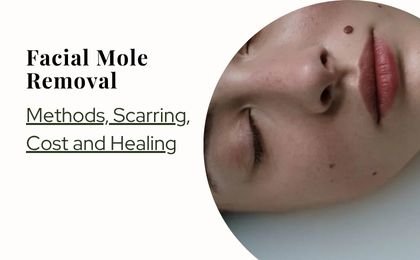
A facial mole may feel like a defining beauty mark to one person and an unwanted distraction to another. Some facial moles remain unchanged for years, while others become irritated by shaving, makeup, glasses or repeated touching. A mole may also develop changes that require medical examination rather than purely cosmetic treatment.
Professional facial mole removal begins by identifying the spot correctly. A growth that looks like a common mole could be another type of skin lesion, and a changing pigmented spot may require biopsy. Treating an undiagnosed lesion with acid, heat, freezing products or an at-home “mole remover” can damage healthy skin and delay the diagnosis of a potentially serious condition.
The face also requires additional cosmetic planning. The clinician must consider the mole’s depth, size, shape and location, along with natural facial lines, wound tension, pigmentation risk and your history of scarring. There is no single best mole removal method for every cheek, chin, forehead, nose or lip-area mole.
Clients researching mole removal in Los Angeles can begin with a medical evaluation at our Westwood location. The consultation is convenient for residents of Beverly Hills, Brentwood, Santa Monica, Century City, Bel Air, Culver City and nearby Los Angeles neighborhoods who want clear guidance about removal methods, pathology, scars, healing and cost.
Can You Remove a Mole From the Face?
Yes, many facial moles can be removed by a qualified medical professional. Dermatologists commonly remove moles that are bothersome, cosmetically unwanted or suspicious. Surgical shave removal and surgical excision are two established options, and removed tissue can generally be examined under a microscope when medically appropriate.
However, the answer to can you remove a mole depends on several factors:
- Whether the growth is actually a mole
- Whether it has changed
- Its width and depth
- Whether it is flat or raised
- Its location on the face
- Whether pathology is necessary
- Your tendency to develop dark marks
- Your history of thick or raised scars
- How much visible scarring you consider acceptable
A small raised mole on the jawline may be suitable for a different technique than a flat pigmented lesion near the eyelid. A spot beside the nostril or lip may also need special closure planning because movement and natural facial contours can influence healing.
When a Facial Mole Needs Medical Evaluation
Most moles do not require treatment, but a new, growing, itching, bleeding or changing mole should be examined promptly. In adults, a newly appearing mole or a noticeable change in an existing mole can be an early sign of melanoma.
Arrange a dermatology evaluation when a mole:
- Becomes asymmetrical
- Develops an irregular border
- Contains several colors
- Changes in shape, size or elevation
- Starts bleeding without an obvious injury
- Itches or becomes painful
- Forms a persistent crust or sore
- Looks different from your other moles
- Returns after a previous removal
A suspicious lesion should not be destroyed cosmetically before diagnosis. A skin biopsy allows tissue to be examined by a dermatopathologist, and the result helps determine whether additional care is required.
How to Get a Mole Removed From the Face
The safest answer to how to get a mole removed is to arrange an examination with a dermatologist or another appropriately qualified clinician experienced in skin lesions.
Step 1: Medical and Skin History
The clinician may ask:
- How long the mole has been present
- Whether its appearance has changed
- Whether it bleeds, itches or hurts
- Whether it becomes irritated by shaving or makeup
- Whether you have had previous moles removed
- Whether you or a family member has had skin cancer
- Which medications and supplements you take
- Whether you use blood-thinning medication
- Whether you have diabetes or an immune condition
- Whether you develop keloids or thick scars
- Whether minor injuries leave persistent dark marks
Do not stop prescribed medication independently. Any medication change should be directed by the prescribing clinician and the professional performing the procedure.
Step 2: Examination of the Mole
The clinician evaluates the mole’s:
- Shape
- Border
- Color
- Surface
- Diameter
- Elevation
- Depth
- Surrounding skin
- Relationship to nearby facial structures
The examination determines whether the spot should be monitored, biopsied, shaved, completely excised or referred for specialist treatment.
Step 3: Selecting the Procedure
Before treatment, the clinician should explain:
- Which mole removal procedure is recommended
- Why that method suits the lesion
- Whether stitches will be needed
- Whether tissue will be sent to a laboratory
- The expected wound size
- The likely scar shape
- The risk of recurrence
- The expected healing period
- The complete mole removal cost
Step 4: Numbing the Area
Local anesthetic is commonly injected around the mole. The injection may briefly sting, but the area should then become numb.
You may feel pressure or movement during removal. Sharp pain should be reported immediately so the clinician can check the anesthesia.
Step 5: Removal and Dressing
The mole is removed using the planned technique. The clinician controls bleeding, closes the wound when necessary and applies an appropriate dressing.
Step 6: Pathology and Follow-Up
When tissue is submitted for laboratory examination, a dermatopathologist reviews it under a microscope. The treating clinician then explains the result and whether further treatment or monitoring is necessary.
Surgical Shave Removal for a Facial Mole
A surgical shave is frequently considered for suitable raised moles. The clinician uses a sterile surgical blade to remove the visible growth at or near the surrounding skin level.
Possible Advantages
A shave procedure may:
- Be completed during an office appointment
- Avoid stitches in selected cases
- Produce a relatively small surface wound
- Be appropriate for certain raised benign moles
- Provide tissue for microscopic examination
Possible Limitations
A shave may leave mole cells below the skin surface. This can result in:
- Residual color
- A slight indentation
- A lighter or darker mark
- Regrowth
- A need for future reassessment
A superficial result is not always the best cosmetic result. Shaving too shallowly can leave a visible portion of the mole, while removing more deeply may create a more noticeable depression or scar.
Is Shave Removal Scar-Free?
No. Any procedure that breaks the skin can leave a scar. A shave site may heal as a flat mark, a lighter or darker area, a slight indentation or a raised scar.
Promises of completely invisible mole on face removal should be treated cautiously. The final appearance depends on the mole, procedure, location, wound care and individual healing response.
Facial Mole Removal Surgery
Mole removal surgery usually refers to surgical excision. During excision, the clinician cuts around and beneath the mole to remove it at an appropriate depth. The wound is generally closed with stitches.
When Excision May Be Recommended
Excision may be selected when:
- The mole extends more deeply
- Complete removal is preferred
- The lesion has suspicious characteristics
- An intact specimen is important
- The mole returned after a previous shave
- Its shape or location makes surgical closure more appropriate
Benefits of Excision
Excision can:
- Remove deeper mole tissue
- Provide a complete specimen for pathology
- Reduce the likelihood of visible recurrence
- Allow controlled closure of the wound
Limitations of Excision
The final scar is usually longer than the mole’s visible diameter because the wound must be shaped so its edges can close smoothly.
The scar may initially look:
- Pink or red
- Slightly swollen
- Firm
- Darker than the surrounding skin
- More visible than expected
Scars commonly change over several months. A surgical scar may gradually soften and fade, but no clinician can guarantee that it will disappear completely.
The phrase removing mole surgery is sometimes used in searches, but surgical excision is the clearer term to use during a medical consultation.
Shave Removal vs Mole Removal Surgery
Shave Removal
A surgical shave may be more suitable for a raised mole that appears benign and does not require deep removal.
It often:
- Produces a round or oval surface wound
- Does not require stitches
- Has a possibility of regrowth
- Can leave a flat, indented or discolored mark
Surgical Excision
Excision may be more appropriate for a deeper, recurrent or suspicious mole.
It usually:
- Removes tissue at greater depth
- Requires stitches
- Produces a linear scar
- Supplies a fuller specimen for pathology
- May reduce recurrence when the mole is completely removed
Neither method is automatically better. The best mole removal option is the one that balances diagnosis, depth, recurrence risk, facial location and scar expectations.
Laser Surgery for Moles
Laser surgery for moles is frequently promoted as a quick and scar-free option. That description can be misleading.
Laser energy destroys targeted tissue rather than cutting out an intact specimen. Because suspicious moles may need microscopic examination, an undiagnosed or changing mole should not simply be erased with a destructive treatment. This is why medical evaluation must come before considering laser treatment.
A dermatologist may consider a laser or another energy device for a carefully diagnosed benign lesion in selected circumstances. Before proceeding, ask:
- Has the spot been confidently diagnosed?
- Why is laser recommended instead of shave removal or excision?
- Will tissue be available for pathology?
- Can the pigmentation return?
- Could treatment leave a white or dark mark?
- How many sessions may be required?
- What happens if the mole grows back?
Laser treatment can still cause:
- Redness
- Swelling
- Crusting
- Hyperpigmentation
- Hypopigmentation
- Uneven texture
- Scarring
- Incomplete removal
The word “laser” does not automatically mean a more precise or less visible result.
Mole Removal on Different Facial Areas
Cheek Mole Removal
The cheeks offer relatively broad skin surfaces, but natural expression and skin tension still affect scar placement.
A raised benign cheek mole may be evaluated for shave removal, while a deeper or suspicious lesion may require excision.
Chin and Jawline Mole Removal
Moles around the chin or jawline often become irritated by shaving. The clinician should consider hair follicles, repeated movement and the direction of natural skin tension.
Nose Mole Removal
The nose has limited movable skin, strong contours and cosmetically sensitive subunits. A small wound can be highly visible, so the procedure may require more specialized planning.
Forehead and Temple Mole Removal
The forehead is exposed to sunlight and facial movement. Scar direction and sun protection are important considerations.
Mole Removal Near the Eyes
Moles near the eyelids or lash line require detailed examination because of the eye’s proximity and the eyelid’s functional role. Referral to a specialist may be appropriate.
Mole Removal Near the Lips
The lip area moves frequently during speaking, eating and facial expression. The clinician must consider the lip border, nearby nerves, wound tension and scar placement.
Will Facial Mole Removal Leave a Scar?
All procedures that injure the skin can produce a scar. Scarring is part of the body’s normal repair process. Good technique and proper aftercare can help a scar become less noticeable, but they cannot guarantee scarless healing.
The final scar may depend on:
- Mole size and depth
- Facial location
- Removal method
- Direction of wound closure
- Infection or wound separation
- Sun exposure
- Skin tone
- Age
- Smoking
- Medical conditions
- Keloid history
- Aftercare
Flat Scar
Many wounds eventually heal as a flat mark that becomes less noticeable over time.
Depressed Scar
A shave or deep removal can occasionally leave an indentation, particularly when the mole extended beneath the surface.
Raised or Keloid Scar
Some people develop thickened scars. A personal or family history of keloids should be discussed before treatment.
Pigmentation Changes
The area may become darker or lighter than the surrounding skin. This can be temporary or persistent, especially after inflammation or sun exposure.
Facial Mole Removal Healing Timeline
First 24–72 Hours
The site may appear pink, red, slightly swollen or bruised. Mild tenderness and limited spotting on the dressing can occur.
Follow the clinician’s instructions about the original dressing and cleansing.
Days 3–10
The wound begins closing. Mild itching may occur as the skin heals.
Many small biopsy-type wounds heal in approximately seven to ten days, although deeper wounds and some facial locations can take longer.
Weeks 2–6
The surface may be closed while the scar remains pink, brown, firm or sensitive. Stitched areas may feel tight.
Do not judge the final result during this stage.
Following Months
Scar color and firmness gradually change. The area may soften and become less noticeable, but scar maturation can take several months.
Contact the clinician if a removed mole returns. Regrowth should be medically reassessed rather than treated at home.
Facial Mole Removal Aftercare
Follow the instructions provided for your specific wound.
General wound care may include:
- Wash your hands before touching the site.
- Remove the dressing gently when instructed.
- Clean the area with mild soap and water.
- Avoid scrubbing.
- Pat the surrounding skin dry.
- Apply approved petroleum jelly.
- Cover the wound with a clean, non-stick dressing.
- Replace the dressing as directed.
- Avoid picking or scratching.
- Attend pathology and suture-removal appointments.
AAD wound-care guidance recommends keeping many minor dermatologic wounds clean, moist with petroleum jelly and covered. Routine antibiotic ointment is generally unnecessary unless the treating clinician specifically recommends it, because topical antibiotics can cause allergic skin reactions.
Avoid During Early Healing
- Makeup directly over an open wound
- Swimming and hot tubs
- Facial scrubs
- Retinoids near the site
- Exfoliating acids
- Waxing or threading over the wound
- Picking at crusts
- Unapproved scar products
- Excessive stretching of stitched skin
Sun Protection After Closure
Once the wound has healed enough for sunscreen:
- Use broad-spectrum SPF 30 or higher
- Wear a hat outdoors
- Avoid tanning
- Reapply sunscreen during prolonged exposure
Sun protection can reduce persistent red or brown discoloration and support better scar fading.
Santa Monica clients should plan around beach days and outdoor exercise. Century City professionals may prefer scheduling mole removal on face areas before a quieter work period, particularly when stitches or a visible dressing are expected.
Common Problems and Practical Solutions
The Area Is Bleeding
Apply continuous, firm pressure with clean gauze. AAD recommends holding pressure without repeatedly checking the wound; contact the clinician if bleeding does not stop after the advised period.
The Wound Is Becoming More Painful
Mild soreness may be expected, but worsening pain, spreading redness, warmth, pus or fever may indicate infection. Contact the clinic promptly.
The Scar Is Darker Than Expected
Early pigmentation may fade gradually. Protect the area from sunlight and avoid strong bleaching products until the wound is fully healed and professionally assessed.
The Site Looks Indented
An indentation may improve as healing continues, but some depressions persist. Wait for appropriate scar maturation before considering corrective treatment.
The Mole Is Returning
Do not shave, burn or apply chemicals to the regrowth. A returning mole should be examined, especially if it looks different, changes or bleeds.
What Is the Best Mole Remover?
There is no safe best mole remover for unsupervised home use.
The FDA states that no over-the-counter drug can legally be sold for removing moles or skin tags. Products marketed for this purpose may cause burns, infection, scars and delayed diagnosis of skin cancer.
Avoid:
- Acid-based mole-removal products
- Bloodroot or black salve
- Wart-removal liquids
- Cutting tools
- Home cautery devices
- Unregulated freezing products
- Tying off a mole
- Scraping or shaving it yourself
Some corrosive products can destroy both abnormal and healthy tissue. FDA warnings describe tissue damage associated with products containing corrosive ingredients such as bloodroot and zinc chloride.
Professional skin mole removal is safer because the lesion is examined, sterile equipment is used, bleeding is controlled and tissue can be tested when necessary.
Facial Mole Removal Cost
Mole removal cost varies according to:
- Number of moles
- Size and depth
- Facial location
- Shave removal or excision
- Need for stitches
- Pathology fees
- Provider qualifications
- Facility charges
- Follow-up care
- Scar-management needs
Cosmetic removal is commonly self-pay, while evaluation or removal for a suspicious or symptomatic lesion may be handled differently. Coverage depends on the insurance plan, diagnosis and medical documentation.
When comparing mole removal Los Angeles CA providers, request a written estimate showing whether it includes:
- Consultation
- Procedure
- Local anesthetic
- Pathology
- Suture removal
- Follow-up
- Scar review
A low advertised price may not include pathology or aftercare. Cost should be considered alongside diagnosis, provider qualifications and access to follow-up.
Frequently Asked Questions
Can You Remove a Mole From the Face?
Yes. Many facial moles can be removed through surgical shave removal or excision. The appropriate method depends on the lesion’s diagnosis, depth, location and need for pathology.
How Do I Get a Mole Removed?
Schedule a medical skin examination. The clinician will determine whether the mole should be monitored, shaved, excised, biopsied or referred for another type of care.
What Is the Best Mole Removal Method for the Face?
The best mole removal method depends on the mole. A raised benign mole may be suitable for a shave, while a deeper, recurrent or suspicious lesion may require surgical excision.
Does Mole on Face Removal Leave a Scar?
Yes, a scar is possible whenever the skin is cut or otherwise injured. Its appearance depends on the removal method, wound depth, location, skin type and healing.
Is Mole Removal Surgery Painful?
Local anesthetic is commonly used. The injection may sting briefly, and mild soreness can occur after the numbness wears off.
Is Laser Surgery for Moles Better Than Excision?
Not necessarily. Laser destroys tissue and may not provide a complete specimen for laboratory examination. Excision may be more appropriate when diagnosis or deeper removal is needed.
How Long Does Facial Mole Removal Take to Heal?
A small surface wound may close in approximately one to two weeks. Deeper or stitched wounds may require longer, and scar maturation can continue for several months.
Can a Facial Mole Grow Back?
Yes. Regrowth can occur when mole cells remain beneath the skin. Any returning mole should be medically examined.
How Much Does Facial Mole Removal Cost?
Pricing depends on the mole’s size, depth and location, removal technique, stitches, pathology and follow-up. A consultation is necessary for an accurate estimate.
How Do I Get Several Moles Removed?
For anyone asking how to get moles removed, each lesion should be evaluated separately. Several suitable moles may sometimes be treated during one appointment, while others may require staged procedures or biopsy.
Plan Facial Mole Removal With Confidence
Successful facial mole removal begins with an accurate diagnosis, a carefully selected procedure and realistic expectations about scarring.
Book a professional consultation in Westwood to discuss your mole, removal options, pathology, healing timeline and complete cost.
Book Your Free Consultation
Get expert advice and a personalized treatment plan—no commitment required