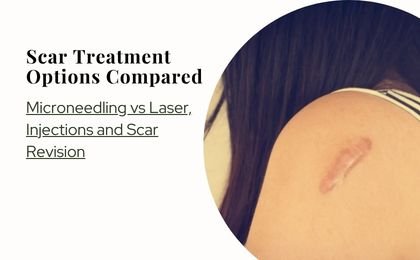
Scar Treatment Options Compared: Microneedling vs Laser, Injections and Scar Revision
Choosing a scar treatment can become confusing quickly. Search online and you may find microneedling promoted for acne scars, lasers promoted for almost every skin concern, injections for raised scars, chemical peels for facial texture, and scar removal surgery for scars that have not responded to other treatments.
The important point is that these procedures are not interchangeable.
A depressed acne scar is fundamentally different from a thick hypertrophic scar. A keloid behaves differently from a mature surgical scar. A scar that is mainly red may need a different strategy from one that is deeply indented, and some people have several scar types in the same treatment area. Dermatologists therefore individualize scar care according to scar type, number, location, skin tone, medical history, and other factors rather than recommending one universal procedure.
For clients researching scar treatments in Los Angeles, understanding these differences can help you ask better questions during consultation and avoid choosing a procedure simply because it is currently popular.
Our Westwood location provides convenient access for clients from Beverly Hills, Brentwood, Santa Monica, Century City, Bel Air, Culver City, and surrounding Los Angeles neighborhoods seeking a more personalized approach to scar improvement.
The First Question: What Type of Scar Do You Have?
Before comparing devices and procedures, determine what actually needs treatment.
Depressed acne scars sit below the surrounding skin. Raised hypertrophic scars contain excess scar tissue but remain within the original wound area. Keloids can extend beyond the boundaries of the original injury. Surgical scars may become wide, raised, discolored, depressed, or restrictive depending on how they heal. Scars can also cause symptoms including pain, itching, stiffness, or reduced movement.
That is why asking “What is the best scar treatment?” is less useful than asking:
What is the best treatment for my particular type of scar?
The answer may be microneedling, laser treatment, medication injections, resurfacing, surgical revision, or a combination.
Scar Treatment Comparison at a Glance
| Treatment | Often Considered For | Main Goal | Important Limitation |
|---|---|---|---|
| Microneedling | Selected depressed facial acne scars and certain abdominal surgical scars | Improve scar appearance through controlled skin remodeling | Not appropriate for every scar or patient |
| Laser or light treatment | Selected acne scars, redness, raised scars, keloids, and some symptomatic scars | Improve color, texture, thickness, or symptoms depending on device | Different lasers treat different problems |
| Chemical peels | Selected depressed acne scars and surface irregularities | Improve texture and encourage remodeling | Strength and suitability vary |
| Medical injections | Raised hypertrophic scars and keloids | Reduce excessive scar tissue and symptoms | Usually not used for depressed acne scars |
| Fillers | Selected depressed or concave scars | Temporarily raise depressed areas | Results may require maintenance |
| Scar revision surgery | Wide, poorly positioned, contracted, or structurally problematic scars | Replace or reposition an unfavorable scar | Surgery creates another scar |
| Silicone/pressure approaches | Selected raised scars and some surgical scars | Reduce scar prominence or abnormal scar development | Results take time and depend on scar type |
These are broad categories rather than treatment recommendations. A medical professional needs to determine whether an individual procedure is appropriate.
Microneedling for Scar Treatment
Microneedling creates controlled punctures in the skin using multiple fine needles. FDA has legally authorized specific microneedling medical devices to improve the appearance of facial acne scars and abdominal scars in people aged 22 years and older. More than one treatment may be required.
For suitable depressed acne scars, microneedling may be considered as part of a facial scar treatment plan because the healing response can lead to remodeling that makes the scars less noticeable. Dermatologists may also combine microneedling with other scar treatments when appropriate.
Microneedling is not a generic scar removal treatment for every visible mark.
It should not automatically be used over keloids, active infections, inflammatory skin disease, suspicious lesions, or skin that is not an appropriate candidate for controlled injury. FDA lists a history of keloids, active infection, certain immune or bleeding problems, uncontrolled diabetes, pregnancy, breastfeeding, some inflammatory skin diseases, recent isotretinoin use, and other factors among situations requiring avoidance or additional medical consideration.
Microneedling vs Laser for Acne Scars
Both treatments can be used for selected acne scars, but they work differently.
Microneedling mechanically creates controlled micro-injuries. Laser resurfacing uses controlled light energy to alter targeted skin tissue. AAD includes both among treatment options for depressed acne scars and notes that several treatment methods may be combined when patients have different scar characteristics.
The right choice can depend on scar depth, scar pattern, skin tone, previous treatments, recovery preferences, and the specific technology being considered.
For example, a person with several shallow depressed acne scars may receive a different skin scar treatment plan from someone with a combination of deep scars, redness, and significant uneven texture.
This is why choosing between “laser” and “microneedling” based purely on which sounds stronger is not particularly useful.
A Special Note About RF Microneedling
Radiofrequency microneedling is not the same procedure as standard mechanical microneedling. It delivers RF energy through microneedles to heat tissue below the surface.
In October 2025, FDA issued a safety communication after receiving reports of serious complications from certain aesthetic uses of RF microneedling, including burns, additional scarring, unintended fat loss, nerve damage, disfigurement, and cases requiring further medical or surgical treatment. FDA describes RF microneedling as a medical procedure and recommends choosing a licensed healthcare professional trained and experienced with these devices.
For someone already concerned about scarring, this makes proper candidate selection and medical expertise particularly important.
RF microneedling should therefore not be marketed as a universally safe or casual facial scar treatment.
Laser Scar Treatment
“Laser treatment” is another broad term rather than one procedure.
Different lasers and light devices interact with skin in different ways. Dermatologists may use appropriately selected laser or light treatments to improve redness, reduce some raised scars or keloids, treat selected depressed acne scars, and in some situations improve scar-related pain, itching, firmness, swelling, or restricted movement.
The best treatment for scars is not simply “laser” because the device needs to match the treatment target.
A scar that is predominantly red may need a color-focused approach. A depressed acne scar may require resurfacing or combination treatment. A raised scar may be treated with laser plus another medical approach such as injections. AAD specifically notes that dermatologists may combine light-based treatments with injected medication for raised scars.
Microneedling vs Laser: Which Has Less Downtime?
Recovery varies considerably according to treatment depth, device, scar location, and individual response.
FDA describes common microneedling effects including redness, dryness, tightness, itching, peeling, discomfort, bruising, bleeding, and crusting. Less common problems include pigmentation changes, herpes reactivation, swollen lymph nodes, and infection.
Laser downtime varies too widely to provide one universal timeline because non-ablative treatment and deeper resurfacing are very different procedures.
A consultation should therefore compare not just potential results but also the specific recovery associated with the actual device and settings proposed for you.
Chemical Peels for Facial Scar Treatment
Chemical peeling may be used for selected depressed acne scars. AAD describes peels ranging from milder to stronger treatments and notes that some treatment plans require several sessions.
A chemical peel is generally better viewed as one tool within a broader facial scar treatment strategy rather than a universal scar-removal solution.
It may be considered when surface texture and certain depressed scars are concerns, but it will not flatten a keloid or correct a scar contracture.
The depth of the peel matters significantly. Medical-level scar treatments that penetrate beyond superficial cosmetic treatment must remain within the appropriate professional scope in California. The Medical Board of California specifically considers procedures performed to remove scarring or other deeper blemishes medical treatments rather than routine esthetic services.
Medical Injections for Raised Scars
Medical injections serve a very different purpose from microneedling.
When scar tissue is raised because the body produced too much collagen, dermatologists may inject medications such as corticosteroids or other agents directly into the scar. AAD describes these treatments as options for hypertrophic scars and keloids and notes that repeat treatments or combinations may be required.
This illustrates an important treatment principle:
A depressed scar may need support or remodeling that improves its depth, while a raised scar may need treatment that reduces excess tissue.
Using the same procedure for both makes little biological sense.
Keloid Scar Treatment Is Different
Keloids deserve additional caution because they can continue growing beyond the original injury and may recur after treatment.
AAD describes several possible medical approaches, including injections, freezing treatment, lasers, pressure methods, and surgery in selected cases. Combination therapy is often used because recurrence can be a significant problem.
This means someone with a keloid should not simply book microneedling because they saw the phrase “scar treatment” advertised online.
Creating additional skin injury in someone who tends to form abnormal scars may be inappropriate.
Surgical Scar Treatment
Surgical scar treatment becomes relevant when the problem is structural.
Examples can include a wide scar, an unfavorably positioned scar, a contracture that restricts movement, or a scar whose shape makes nonsurgical improvement limited.
During surgical revision, a plastic surgeon may remove the old scar and close the new incision more strategically. More complex scars can require layered closure, tissue rearrangement, Z-plasty, W-plasty, flap techniques, grafting, or other reconstructive approaches depending on the individual problem.
This is why the commonly searched term scar removal surgery is somewhat misleading.
The procedure does not erase scar formation. It creates a new surgical wound with the intention that the resulting scar will be less conspicuous, better positioned, or more functional.
Scar Revision Surgery vs Laser Treatment
Neither is universally better.
Laser treatment may be more appropriate when scar color, surface characteristics, selected raised tissue, or certain acne scars are the primary concern. Surgery may make more sense when the scar’s width, orientation, contracture, or deeper structure needs to be physically changed.
Some patients eventually use both.
A scar can first be surgically revised and later receive topical, injectable, laser, or other treatment as it heals. ASPS notes that scar-revision plans may combine topical care, injectable treatment, resurfacing, and surgery depending on scar severity and characteristics.
Scar Removal vs Scar Improvement
The phrase best scar removal attracts attention because people understandably want scars gone.
The more medically accurate goal is often scar minimization.
A scar treatment may make a scar flatter, smoother, less red, less indented, narrower, more flexible, or less noticeable, but treatment generally does not restore tissue to an untouched pre-injury state. ASPS describes scar revision as an attempt to make a scar less conspicuous and better integrated with surrounding skin.
The best scar removal plan therefore means the strategy most likely to improve the feature that bothers you—not necessarily the procedure that makes the most dramatic advertising claim.
Which Treatment Is Better for Surgical Scars?
Surgical scar treatment depends on what is wrong with the scar.
If a scar is relatively new, some cases may benefit from conservative management while the tissue continues to mature. If it is raised, silicone or medically directed treatment may be considered. If it is red, a qualified dermatologist may consider an appropriate laser or light treatment. A wide, contractured, or poorly positioned mature scar may eventually require surgical revision.
Microneedling is also FDA-authorized through specific devices for improving the appearance of abdominal surgical scars in adults aged 22 and older, but that authorization does not mean every surgical scar anywhere on the body should automatically be microneedled.
Facial Scar Treatment Requires Extra Planning
A facial scar treatment can involve several issues at the same time.
Someone may have depressed acne scars, lingering discoloration, enlarged pores, active breakouts, and uneven skin texture. Treating one feature without considering the others can limit the result.
AAD states that acne-scar treatment plans take into account scar types, number of scars, skin tone, age, budget, and other individual factors. Active acne is commonly addressed first so new breakouts do not continue producing additional scars during treatment.
For clients from Beverly Hills, Brentwood, Century City, or Santa Monica seeking facial scar treatment in Westwood, the consultation should therefore evaluate the entire scar pattern rather than selecting one device from a menu.
What If You Have Several Types of Acne Scars?
Combination treatment is often particularly relevant.
One scar may respond better to a procedure that releases or lifts depressed tissue, while another area may benefit more from resurfacing or microneedling. AAD describes combinations such as scar procedures followed by fillers or other modalities when different depressed scars require different approaches.
This is why a single “acne scar package” may not represent the best treatment for scars across an entire face.
Which Treatment Has the Fastest Results?
There is no meaningful universal winner.
Some treatments create gradual remodeling over multiple sessions. Fillers may change the appearance of selected depressed scars more quickly but can require maintenance. Surgical revision changes the scar structurally but then begins another scar-healing process. Laser and microneedling outcomes develop as the skin heals and remodels.
Speed should therefore be considered alongside safety, recovery, durability, scar type, and the degree of improvement you realistically need.
How Many Scar Treatment Sessions Will You Need?
The number depends on the procedure.
FDA notes that more than one microneedling procedure may be needed and that future maintenance can sometimes be required. AAD describes multiple sessions for several acne-scar treatments and emphasizes individualized planning.
Surgery follows a different model: there may be one operative procedure, but scar maturation and final improvement can continue long afterward.
Do not assume the treatment with fewer appointments is automatically the better choice.
Scar Treatment Aftercare
Aftercare should match the procedure.
Following microneedling, FDA notes that treated skin may temporarily become more sensitive to sunlight and to products including makeup, moisturizers, retinoids, glycolic acid, alcohol-containing products, and other potentially irritating ingredients.
Laser treatment, injections, chemical peels, and surgery all have different aftercare needs.
The treating professional should tell you when you can resume skincare, exercise, sun exposure, makeup, swimming, or other activities rather than relying on generic online instructions.
When Should Scar Treatment Be Postponed?
The answer depends on the procedure and medical history.
For medical microneedling, FDA advises additional caution or avoidance with conditions including active infections, bleeding disorders, anticoagulant therapy, immune suppression, uncontrolled diabetes, inflammatory skin diseases, keloid history, certain recent medications, suspicious lesions in the treatment area, pregnancy, breastfeeding, and other concerns.
A scar-like lesion that developed without a remembered injury should also receive medical assessment because AAD notes that skin cancer can occasionally resemble or develop within scarred tissue.
Do not simply resurface or microneedle a changing, bleeding, unexplained, or suspicious lesion.
Choosing Scar Treatments in Los Angeles
When researching scar treatments in Los Angeles, the provider should be able to explain why a particular procedure is being recommended.
California’s Medical Board states that deeper treatments intended to remove scarring are considered medical procedures. It also states that medical assistants cannot use lasers to remove scars or similar blemishes, and estheticians may perform only treatments that remain within their non-medical scope.
Before choosing a treatment, ask who will perform it, what qualifications they hold, what scar feature is being targeted, what alternatives exist, what recovery is expected, and what happens if complications occur.
A Westwood location can make multiple treatment and follow-up visits convenient for clients from Beverly Hills, Brentwood, Santa Monica, Century City, Bel Air, Culver City, and nearby neighborhoods—but clinical suitability should matter more than proximity alone.
Common Scar Treatment Problems and Solutions
“I Had Microneedling but My Raised Scar Did Not Improve.”
The problem may be that the scar was not an appropriate microneedling target.
A raised hypertrophic scar or keloid involves excess scar tissue rather than the deficit seen in a depressed acne scar. Medical evaluation can determine whether injections, laser treatment, or another scar-specific option is more appropriate.
“Laser Treatment Improved the Redness but I Still See a Depression.”
The laser may have successfully addressed one component of the scar while another remains.
Depressed scars sometimes require a different resurfacing, lifting, filling, microneedling, or surgical strategy depending on the scar pattern.
“My Surgical Scar Is Too Wide.”
Surface treatment alone may not correct a significant structural width problem.
A plastic surgeon can determine whether scar removal surgery, more accurately called scar revision, is appropriate.
“I Want One Procedure That Treats Every Acne Scar.”
Different acne scars can require different approaches.
Combination facial scar treatment may provide greater value than repeatedly using one procedure on every scar regardless of its shape.
“I Want the Strongest Treatment Available.”
More aggressive does not automatically mean better.
The appropriate treatment should match your scar, skin, health history, and desired improvement. RF microneedling, for example, has documented reports of serious complications with certain aesthetic uses, reinforcing the importance of medical selection rather than choosing purely by treatment intensity.
Frequently Asked Questions
What Is the Best Scar Treatment?
The best scar treatment depends on whether your scar is depressed, raised, keloidal, surgical, discolored, or restrictive. Dermatologists commonly select or combine treatments according to scar type and individual factors rather than using one procedure for everyone.
Is Microneedling the Best Treatment for Scars?
Microneedling can be appropriate for selected scars. FDA-authorized devices include indications for improving facial acne scars and abdominal scars in adults aged 22 or older. It is not appropriate for every scar or every patient.
Is Laser Better Than Microneedling for Facial Scars?
Neither is universally better. Laser and microneedling affect skin differently, and the choice depends on the scar type, depth, color, skin characteristics, and treatment goal. Some acne-scar plans use more than one approach.
Can Injections Remove Raised Scars?
Dermatologists use corticosteroids and certain other injected medications to reduce selected hypertrophic scars and keloids. Multiple sessions or combination treatment may be required.
What Is Surgical Scar Treatment?
Surgical scar treatment involves revising or repositioning scar tissue so the resulting scar may be less noticeable or more functional. Techniques can range from straightforward excision and closure to more complex tissue rearrangement.
Does Scar Removal Surgery Permanently Remove a Scar?
No. Scar removal surgery produces another incision and therefore another scar. The objective is to create a better-positioned, less conspicuous, or more functional result rather than scar-free skin.
What Is the Best Scar Removal Treatment for Acne Scars?
There is no universal best scar removal procedure for acne scars. Treatment may involve microneedling, laser resurfacing, chemical peels, fillers, minor scar procedures, or combinations depending on the specific depressed scars.
Can Old Scars Still Be Treated?
Some mature scars can still be improved. The appropriate treatment for scars depends more on their present color, thickness, depth, texture, symptoms, and location than on age alone. Treatment may range from resurfacing to surgical revision depending on the individual scar.
Is RF Microneedling Safe for Scar Treatment?
RF microneedling is a medical procedure. FDA reported serious complications with certain aesthetic uses in 2025, including burns, scarring, fat loss, nerve injury, and disfigurement. Patients considering it should discuss risks and alternatives with a licensed healthcare professional trained in the device.
Where Can I Find Scar Treatments in Los Angeles?
When considering scar treatments in Los Angeles, begin with an assessment that determines your scar type and whether microneedling, laser treatment, injections, resurfacing, or surgical scar treatment is appropriate. Westwood is conveniently located for Beverly Hills, Brentwood, Santa Monica, Century City, Bel Air, Culver City, and nearby Los Angeles neighborhoods.
Choose the Treatment That Matches the Scar
The best treatment for scars is not automatically microneedling, laser treatment, injections, or surgery. Each method addresses different scar characteristics, and combination treatment can sometimes provide a more logical approach than repeatedly using one procedure.
Book your Westwood scar consultation to discuss your scar type, skin scar treatment options, facial or surgical scar concerns, expected recovery, realistic improvement, and whether nonsurgical treatment or scar removal surgery deserves consideration.
Book Your Free Consultation
Get expert advice and a personalized treatment plan—no commitment required