
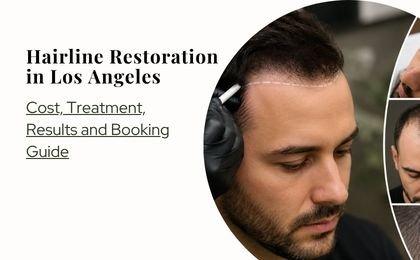
Hairline Restoration in Los Angeles: Cost, Treatment, Results and Booking Guide
A receding hairline can change the apparent proportions of the face even when significant natural hair remains elsewhere on the scalp. Temple recession, frontal thinning, an uneven hairline, or increased scalp visibility often leads people to research hairline restoration in Los Angeles and compare cosmetic, medical, and surgical solutions.
The challenge is that hair restoration is a broad term. A hair transplant relocates real follicles from donor areas. Medical treatments may be appropriate for certain diagnosed causes of hair loss. Cosmetic scalp micropigmentation, or SMP, takes another approach: carefully placed pigment impressions create the visual appearance of very short follicles and can redefine selected areas of a receding hairline.
Our hairline restoration service focuses on cosmetic SMP rather than surgical transplantation. SMP does not grow hair or stop future hair loss. It is a tattoo-based camouflage technique intended to improve the visible shape and density of the hairline.
For clients traveling to Westwood from Beverly Hills, Brentwood, Santa Monica, Century City, Bel Air, Culver City, and nearby Los Angeles neighborhoods, this guide explains treatment, pricing, design, healing, maintenance, comparisons, safety, and the questions worth asking before booking.
What Is Hair Restoration?
If you are researching what is hair restoration, start by understanding that there is no single procedure with that name.
Hair restoration can include several approaches:
- Surgical hair transplantation
- Medical management of certain forms of hair loss
- Scalp micropigmentation
- Temporary hair fibers
- Scalp concealers
- Hair replacement systems
- Combination approaches
A surgical hair transplant uses existing hair from donor areas and relocates follicles to areas of thinning or baldness. Suitable candidates generally need sufficient healthy donor hair, commonly at the back and sides of the scalp. Hair characteristics and donor availability can affect what surgery can realistically accomplish.
Cosmetic hairline restoration through SMP does not move hair follicles. Instead, pigment is placed in the scalp to imitate the appearance of closely shaved follicles or reduce the contrast created by exposed scalp.
That means the right treatment starts with a simple question: Do you want actual growing hair, or do you want to improve the visual appearance of your hairline?
How Hairline Restoration With SMP Works
The goal of SMP is not to paint a hairline onto the forehead.
A successful hair restoration procedure uses many small pigment impressions placed strategically through areas affected by recession or thinning. On a closely shaved scalp, those impressions can visually blend with existing short follicles.
At the frontal hairline, treatment may help:
- Recreate a stronger-looking boundary
- Reduce the appearance of temple recession
- Improve uneven frontal recession
- Connect thinning areas with existing follicles
- Create a more balanced facial frame
For clients with some remaining hair, pigmentation may also reduce the contrast between darker hair and lighter exposed scalp.
The result remains cosmetic. There are no additional follicles underneath the pigment, so SMP should never be marketed as biological restoration of hair.
Who Is a Good Candidate for Cosmetic Hairline Restoration?
SMP may be worth considering when your primary concern is appearance rather than actual hair regrowth.
Potential candidates may have:
- A receding frontal hairline
- M-shaped recession
- Temple thinning
- A closely shaved hairstyle
- Male-pattern hair loss with a buzz-cut preference
- Uneven areas along the frontal hairline
- Visible scalp around remaining hair
- Selected healed scalp scars
- Previous hair transplantation with remaining scalp visibility
- Realistic expectations about cosmetic camouflage
Someone seeking long, growing hair across a bald frontal area generally has a different goal and may want to discuss surgical or medical hair restoration services with an appropriately qualified physician.
Hairline Design: The Most Important Part of the Treatment
Choosing the lowest possible hairline is rarely the best strategy.
A convincing design needs to consider:
- Forehead height
- Facial proportions
- Existing hairline
- Temple shape
- Age
- Hair color
- Scalp tone
- Hairstyle
- Degree of recession
- Possible future hair loss
The best hairline restoration should look appropriate not only immediately after treatment but also when viewed from different angles and as the client’s appearance changes over time.
An aggressively low hairline may look unnatural later if surrounding natural hair continues receding.
Soft Hairline vs Defined Hairline
There is also no single correct hairline style.
Soft Hairline
A soft design introduces pigment gradually near the frontal boundary.
This may create:
- A subtler transition
- Less obvious contrast
- More natural irregularity
- An age-appropriate appearance
Defined Hairline
A defined design creates a stronger visual boundary.
Some clients with very short hairstyles prefer this aesthetic, but excessive darkness, perfect symmetry, or an unnaturally straight edge can make SMP easier to detect.
During a Westwood consultation, the design should be personalized rather than selected from a standard stencil.
The Hair Restoration Procedure: Step by Step
Understanding the hair restoration procedure can help you know what you are paying for.
Step 1: Consultation
The consultation reviews the current hairline, temples, scalp condition, existing density, scars, previous SMP or hair transplantation, and desired result.
Sudden, painful, inflamed, or otherwise unexplained hair loss should not simply be camouflaged. Cosmetic treatment does not diagnose the cause of hair loss.
Step 2: Hairline Mapping
The proposed frontal boundary and temples are mapped before pigment is placed.
This stage allows the client and practitioner to evaluate:
- Height
- Shape
- Temple position
- Symmetry
- Softness
- Overall facial balance
Step 3: Pigment Planning
Pigment should visually complement existing follicles and scalp tone.
The objective is not maximum darkness. Fresh pigmentation can also appear stronger than healed work, which is one reason conservative treatment is valuable.
Step 4: Initial Session
The first treatment creates the basic distribution of follicle-like impressions.
Rather than trying to create maximum density immediately, treatment may be built progressively.
Step 5: Healing
The scalp may initially appear red or more intensely pigmented.
After the skin settles, the practitioner can better assess how the individual impressions healed.
Step 6: Refinement
Later sessions may add density, improve temple transitions, balance lighter areas, or refine the frontal design.
Step 7: Final Evaluation
Once the planned treatment has healed, the overall appearance can be assessed before deciding whether additional work is necessary.
How Much Does Hairline Restoration Cost in Los Angeles?
There is no single hairline restoration cost that accurately applies to every client because the size and complexity of the treatment vary.
A small amount of temple recession may require considerably less work than rebuilding a broad frontal hairline and blending it into extensive thinning.
Your hair restoration price may depend on:
- Size of the frontal treatment area
- Degree of temple recession
- Existing hair density
- Hairline complexity
- Number of initial sessions
- Scar camouflage
- Previous SMP
- Corrective work
- Amount of blending required
- Additional scalp areas being treated
- Future maintenance
For this reason, an individualized quote is generally more useful than advertising one universal number.
What Should Be Included in the Hair Restoration Price?
Before booking, ask what the quoted amount actually covers.
A clear treatment quote should explain:
- Whether consultation is included
- Number of anticipated treatment sessions
- Hairline and temple coverage
- Whether refinement is included
- Aftercare support
- Follow-up policy
- When a future session becomes a paid touch-up
- Whether existing SMP correction costs more
- Whether scar work is priced separately
Comparing a single-session advertisement with an all-inclusive treatment plan can make one provider appear less expensive even when the total cost is ultimately higher.
Hairline Restoration Cost vs Hair Transplant Cost
SMP and transplantation should not be compared solely by price because they do not produce the same result.
SMP Hairline Restoration
You are paying for cosmetic camouflage.
There is no donor harvesting and no transplanted hair.
Hair Transplantation
You are paying for surgery that relocates real follicles from donor areas. Hair transplant candidacy depends partly on having usable existing donor hair, and surgery cannot create an unlimited supply of follicles.
Hair-transplant surgery also carries risks such as infection, bleeding, scarring, failure of some grafts to survive, and the possibility that continued natural hair loss later creates an uneven appearance requiring further treatment.
The better question is therefore not “Which costs less?” but “Which outcome matches my goal?”
SMP vs Hair Transplant: Which Is Better for a Hairline?
Choose based on the finished look you want.
SMP May Make More Sense When:
- You prefer a buzz cut or shaved style
- You want cosmetic hairline definition
- You do not need actual growing strands
- Donor hair is not relevant to your cosmetic goal
- You want to reduce visible scalp contrast
- Selected scar camouflage is part of the plan
Hair Transplantation May Make More Sense When:
- Actual growing hair is the priority
- You want longer styling options
- You have suitable donor hair
- You accept surgical treatment and recovery
- A surgeon considers you an appropriate candidate
Hair transplantation relies on existing donor hair, so people with very limited usable hair may have restricted surgical options.
Neither approach is automatically the best hairline restoration for everyone.
Hairline Restoration vs Hair Fibers
Temporary hair fibers can work well when sufficient natural hair remains.
They offer several advantages:
- No needles
- No healing period
- Easy removal
- Easy color adjustment
- No long-term commitment
However, they require ongoing application.
SMP can reduce reliance on daily camouflage, but increased longevity brings increased responsibility when choosing design. Tattoo pigment is not easily removed, and FDA notes that removal can be difficult and may not completely eliminate pigment.
For someone uncertain about hairline position, trying temporary camouflage before committing to SMP can sometimes provide useful perspective.
Hairline Restoration vs Scalp Concealers
Sprays and powders temporarily darken exposed scalp.
They are particularly useful for people who want reversible coverage.
SMP provides a more durable visual change because pigment is implanted into the skin rather than sitting on its surface.
The tradeoff is that a poor cosmetic decision is harder to change.
This is one reason conservative hairline mapping and a portfolio of healed results matter more than dramatic same-day photos.
What Results Should You Expect?
Good cosmetic hairline restoration should improve visual balance without suggesting that physical hair has been created.
The outcome may include:
- A stronger-looking frontal hairline
- Reduced appearance of temple recession
- More balanced left and right sides
- Better integration with a buzzed hairstyle
- Less visible scalp contrast
- More uniform appearance around selected scars
Results should not be described as actual hair growth.
Fresh SMP is also not the best representation of the finished appearance. Redness and newly placed pigment can make the area look temporarily stronger.
Ask to see healed examples when evaluating a provider.
What Happens If Natural Hair Keeps Receding?
This is one of the most important long-term questions.
SMP does not prevent future hair loss.
If untreated natural hair behind or beside the restored area continues receding, additional scalp may become visible.
Possible solutions include:
- Extending SMP into newly exposed areas
- Adjusting pigment density
- Modifying the hairstyle
- Seeking medical evaluation for continuing hair loss
- Combining different approaches where appropriate
Hair transplantation has a similar planning issue: ASPS notes that progressive loss of surrounding natural hair after transplantation can produce an uneven or patchy appearance and may lead to additional surgery.
Long-term planning therefore matters regardless of which hair restoration treatment you choose.
Healing After Hairline Restoration
Immediately after cosmetic SMP, the area may show temporary redness, tenderness, swelling, or stronger-looking pigment.
Healing should generally trend toward improvement rather than increasing inflammation.
Because micropigmentation is a tattoo procedure, recognized risks include infection, allergic reactions, granulomas, abnormal scar formation such as keloids in susceptible people, swelling, burning, and difficulties with pigment removal.
Contact an appropriate healthcare professional if pain, swelling, redness, drainage, fever, or another concerning reaction becomes progressively worse. FDA notes that infections can occur from contaminated tattoo inks, including inks that may have been sealed before use.
Hairline Restoration Aftercare
Follow your practitioner’s specific aftercare instructions.
General early-healing precautions may include:
- Avoid scratching or picking
- Keep the treatment area appropriately clean
- Avoid unnecessary rubbing
- Delay swimming during early healing
- Avoid prolonged soaking
- Limit heavy sweating when advised
- Avoid steam rooms and saunas initially
- Avoid harsh scalp products
- Follow instructions regarding shaving
- Protect the healed scalp from excessive sun exposure
Good aftercare cannot compensate for poor sanitation during treatment, so choosing a properly operated facility remains essential.
Who Should Postpone SMP?
Treatment should generally be delayed when the scalp has:
- Active infection
- Open wounds
- Significant inflammation
- Active folliculitis
- Severe sunburn
- Active dermatitis or eczema
- Active psoriasis in the treatment area
- Recent surgery that has not healed
- A suspicious lesion requiring medical assessment
People with a history of problematic wound healing, severe pigment reactions, or keloid formation should disclose this before tattoo-based treatment. FDA specifically recognizes keloid formation and other scarring as possible tattoo complications.
Choosing Hairline Restoration in Los Angeles
When looking for the best hairline restoration, aesthetics are only one part of the decision.
Los Angeles County identifies micropigmentation as a form of permanent cosmetics/body art. Practitioners performing body art within County jurisdiction are required to register, and body-art facilities require the applicable Public Health permit or license. Pasadena, Long Beach, and Vernon have separate environmental-health jurisdictions.
Los Angeles County states that regulation is intended to address risks including local infection, cross-contamination, and transmission of bloodborne diseases.
Before choosing hairline restoration in Los Angeles, ask:
- Is the practitioner properly registered?
- Is this facility appropriately permitted?
- Can I see fully healed hairline results?
- Do you have examples similar to my recession pattern?
- How will you plan for future hair loss?
- How many sessions are expected?
- What is included in the price?
- How are needles and pigment handled?
- What aftercare will I receive?
- What happens if I dislike the design?
- What is your maintenance policy?
Westwood offers convenient access for clients from Beverly Hills, Brentwood, Century City, Bel Air, Santa Monica, Culver City, and nearby neighborhoods, but convenience should never replace careful evaluation of safety and healed results.
Common Hairline Restoration Problems and Solutions
“I Want My Hairline Much Lower”
A lower hairline is not automatically a better hairline.
Solution: consider forehead proportions, temple shape, age, existing follicles, and possible future recession before finalizing the design.
“My Temples Have Receded More Than My Center Hairline”
Temple treatment should transition gradually into existing follicles.
Solution: customize each side rather than creating an identical geometric shape that ignores natural asymmetry.
“I Want Real Hair, Not an Illusion”
SMP will not meet that goal.
Solution: seek an appropriate medical or surgical hair-restoration consultation and discuss whether you have suitable donor hair for transplantation.
“I Had a Hair Transplant but My Scalp Is Still Visible”
Physical hair may be present without creating the visual density you expected.
Solution: after complete surgical healing and appropriate medical clearance, discuss whether cosmetic camouflage is suitable instead of assuming another transplant is the only option.
“My Previous SMP Hairline Is Too Dark”
Adding more pigment could make the issue worse.
Solution: obtain an experienced assessment before attempting correction. Tattoo pigment can be difficult to remove, and complete removal is not guaranteed.
“I Am Worried SMP Will Look Fake”
Solution: evaluate healed close-up photographs, temple transitions, side profiles, and work on people with hair and skin characteristics similar to yours. Avoid choosing solely on dramatic same-day transformations.
Frequently Asked Questions
What Is Hair Restoration?
Hair restoration is a broad term that can include surgical transplantation, medical hair-loss treatment, cosmetic scalp micropigmentation, and temporary camouflage. Hair transplantation relocates existing donor follicles, while SMP changes the visual appearance of the scalp.
What Is Hairline Restoration With SMP?
SMP hairline restoration uses small pigment impressions to visually recreate closely shaved follicles around areas affected by recession. It is cosmetic camouflage and does not grow new hair.
What Is the Best Hairline Restoration for a Receding Hairline?
The best hairline restoration depends on your objective. SMP may fit someone who wants a shaved-follicle appearance, while transplantation may be more appropriate when actual growing hair is the goal and adequate donor follicles are available.
Does a Hair Restoration Procedure Grow New Hair?
SMP does not. Surgical transplantation moves existing follicles from donor areas rather than creating new follicles.
How Much Does Hairline Restoration Cost?
Hairline restoration cost varies according to frontal coverage, temple recession, number of sessions, existing density, previous SMP, scars, and corrective work. An individualized assessment provides a more useful price than a universal quote.
What Determines the Hair Restoration Price?
The hair restoration price for cosmetic SMP can reflect treatment size, hairline complexity, temple work, session count, previous pigment, scar camouflage, and future maintenance.
Is Hairline Restoration Permanent?
SMP is a tattoo-based, long-lasting treatment. Los Angeles County includes micropigmentation within permanent cosmetics/body art, but visible pigment can change over time and future maintenance may be desired.
Is SMP Better Than a Hair Transplant?
Neither is universally better. SMP provides visual camouflage without growing hair. Transplantation can provide actual growing follicles but requires suitable donor hair and surgery.
Can Hairline Restoration Help With Temple Recession?
Cosmetic pigmentation can visually redefine selected temple areas when the treatment blends naturally with the remaining follicles and the overall frontal hairline.
Where Can I Book Hairline Restoration in Los Angeles?
Our Westwood location is convenient for clients from Beverly Hills, Brentwood, Santa Monica, Century City, Bel Air, Culver City, and nearby communities seeking customized hairline restoration in Los Angeles. Before booking micropigmentation, verify the practitioner’s registration and the facility’s applicable Los Angeles County Public Health status.
Choose a Hairline Restoration Plan Designed for the Long Term
A successful hair restoration treatment begins with realistic goals. Scalp micropigmentation can visually strengthen a receding hairline, hair transplantation can relocate real follicles, and temporary camouflage provides flexibility. The right choice depends on what you want your hairline to look like, how much commitment you prefer, and how your natural hair may change.
Book your Westwood consultation to discuss your hairline shape, temple recession, treatment plan, expected cosmetic results, healing, maintenance, and personalized hairline restoration cost.
Book Your Free Consultation
Get expert advice and a personalized treatment plan—no commitment required