
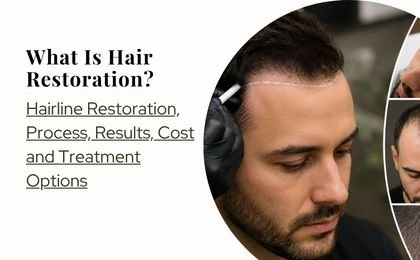
What Is Hair Restoration? A Complete Guide to Hairline Restoration, Treatment Options and Results
A changing hairline can alter the balance of the entire face. Temple recession, frontal thinning, visible scalp, or a higher hairline may become increasingly noticeable even when plenty of natural hair remains elsewhere. For some people, the priority is growing or transplanting actual hair. For others, the goal is cosmetic: creating the appearance of a stronger, more defined hairline without undergoing hair-transplant surgery.
That is why understanding what is hair restoration is important before choosing a treatment. Hair restoration is not one single procedure. The term can include medical treatments designed to slow certain types of hair loss, surgical hair transplantation that relocates existing follicles, temporary camouflage products, and cosmetic scalp micropigmentation that visually recreates the appearance of very short follicles.
For our hairline restoration in Los Angeles service, the focus is cosmetic scalp micropigmentation, or SMP. Carefully placed pigment impressions are used to visually strengthen a receding hairline, soften temple recession, or reduce contrast between existing hair and exposed scalp. SMP does not create new follicles or cause hair to grow. It is a long-lasting cosmetic camouflage technique.
For people in Westwood, Beverly Hills, Brentwood, Santa Monica, Century City, Bel Air, Culver City, and nearby Los Angeles neighborhoods, understanding the differences between these options can help prevent unrealistic expectations and make consultation more productive.
What Is Hair Restoration?
The phrase hair restoration describes techniques intended to improve either the amount of visible hair or the appearance of hair-loss areas.
There are several broad categories.
Medical hair-loss treatment may be used for certain diagnosed forms of hair loss and is intended to slow loss, preserve hair, or encourage growth when medically appropriate.
Surgical hair transplantation relocates existing hair follicles from donor areas, commonly the back or sides of the scalp, into thinning or bald areas. The American Society of Plastic Surgeons explains that transplantation depends on existing donor hair and that hair characteristics and available donor areas influence candidacy and cosmetic outcomes.
Cosmetic hairline restoration with scalp micropigmentation works differently. Rather than moving follicles, pigment is deposited into the scalp to create tiny impressions that visually resemble closely cut follicles.
Therefore, when comparing hair restoration services, the most important question is not simply, “Which procedure is best?” It is:
“What result do I actually want?”
If your priority is growing physical hair, an SMP procedure alone cannot provide that.
If your goal is to visually redefine a receding hairline, create a closely shaved follicular appearance, or reduce scalp contrast without transplant surgery, SMP may deserve consideration.
How Cosmetic Hairline Restoration Works
Cosmetic restoration of hair through scalp micropigmentation relies on visual perception.
When hair is shaved extremely short, each follicle appears as a tiny dark point against the scalp. SMP recreates a similar pattern by placing many controlled pigment impressions into selected areas.
Along the frontal hairline, those impressions can visually extend the appearance of follicles into areas affected by recession.
At the temples, they can soften the transition between areas that still contain hair and areas that have become sparse.
When existing hair remains, pigmentation can sometimes reduce the contrast between the scalp and surrounding hairs, making thinning less obvious.
This does not mean the scalp has gained additional follicles. The hair restoration treatment changes appearance rather than biological hair density.
Who May Benefit From Hairline Restoration With SMP?
Cosmetic SMP may be appropriate for people dealing with several different concerns.
These include:
- Receding frontal hairline
- Temple recession
- Male-pattern hair loss
- Closely shaved or buzz-cut hairstyles
- Visible scalp around the frontal region
- Diffuse thinning with enough remaining hair for visual blending
- Selected hair-transplant scars
- Stable areas of hair loss suitable for camouflage
- Previous hair transplantation with remaining scalp visibility
The most successful plan begins with realistic expectations.
Someone who wants long, growing hair across a bald area is generally looking for a different form of hair restoration procedure than SMP.
Someone who already likes wearing very short hair and wants the hairline to appear stronger may be a much better candidate for cosmetic pigmentation.
Hairline Restoration for a Receding Hairline
A receding hairline does not always disappear evenly.
Common patterns include:
- Temple recession
- An M-shaped hairline
- Frontal thinning
- Uneven left and right recession
- A gradually widening forehead
SMP can be used to visually reconnect these areas with the remaining follicles.
However, natural-looking hairline restoration is not achieved simply by drawing a straight line across the forehead.
The design needs to consider facial structure, forehead height, temple shape, existing follicles, age, and possible future recession.
For example, an excessively low hairline may look appropriate immediately but become less believable as a person gets older or surrounding natural hair continues thinning.
The best hairline restoration generally respects the natural proportions of the face instead of attempting to recreate the exact hairline a person had as a teenager.
Soft Hairline vs Defined Hairline
One of the most important choices during consultation is how defined the new hairline should appear.
Soft Hairline
A softer design uses gradually increasing pigment density and intentional irregularity along the frontal edge.
Advantages include:
- More subtle appearance
- Easier integration with natural follicles
- Less obvious border
- Often more age-appropriate
Defined Hairline
A defined design creates a stronger visual edge.
It may suit people who consistently wear a very short, sharp haircut, but excessive density or perfect symmetry can make cosmetic pigmentation easier to detect.
Neither style is automatically superior.
The right design depends on the face, hairstyle, natural hair pattern, and personal preference.
The Hair Restoration Procedure: Step by Step
A professional hair restoration procedure using SMP should be planned gradually.
Step 1: Consultation
The practitioner reviews your current hairline and scalp.
Important factors may include:
- Degree of recession
- Temple shape
- Existing hair density
- Hair color
- Scalp tone
- Previous SMP
- Previous hair transplant
- Scars
- Preferred hairstyle
- Medical and skin history
- Desired hairline position
This is also the stage where unexplained hair loss should be identified.
Cosmetic pigmentation should not be used as a substitute for diagnosis when hair loss is sudden, inflamed, painful, patchy, or rapidly worsening.
Step 2: Designing the Hairline
The proposed hairline is mapped before pigmentation starts.
Rather than asking only how low the hairline can go, a better design process asks:
Will it suit the face?
Will it connect naturally with existing follicles?
Does it look appropriate from the front and side?
Can it accommodate likely future recession?
Does the temple shape appear believable?
Design decisions can have a greater effect on perceived quality than simply adding more pigment.
Step 3: Pigment Planning
Pigment selection should complement the appearance of the existing follicles and scalp.
The goal is not to make the treated region as dark as possible.
Fresh pigment can also look stronger than healed pigment, making conservative planning particularly important.
Step 4: First Treatment Session
The first session establishes the framework.
Instead of creating maximum density immediately, the practitioner can build an initial layer and then evaluate how the skin and pigment heal.
This approach preserves flexibility.
Step 5: Healing and Assessment
The treatment area may initially look redder and darker.
As the surface settles, the final appearance becomes easier to judge.
Healing also reveals whether certain areas retained less visible pigment than others.
Step 6: Building Additional Density
Later appointments may refine:
- Frontal density
- Temple transition
- Symmetry
- Lighter healed areas
- Connection with natural hair
- Scalp visibility behind the hairline
The purpose is refinement—not automatically making every area darker.
Step 7: Final Review
Once the planned sessions have healed, the overall result can be evaluated.
Future maintenance should be based on actual fading, changes in natural hair, and aesthetic preference.
Hairline Restoration vs Hair Transplant
One of the most important comparisons is SMP versus surgical transplantation.
They are not two versions of the same treatment.
Cosmetic Hairline Restoration With SMP
SMP:
- Creates the appearance of follicles
- Does not grow hair
- Does not require donor hair
- Does not involve transplanting follicles
- Works particularly well with very short hairstyles
- Can reduce scalp contrast
- May require pigment maintenance
- Is difficult to completely reverse because it is a tattoo procedure
Hair Transplantation
A transplant:
- Relocates real follicles
- Can create growing hair
- Requires suitable donor hair
- Is a surgical procedure
- Has a recovery period
- Can produce scars
- Can be affected by continued loss of surrounding natural hair
The American Society of Plastic Surgeons notes that transplantation uses existing donor hair and that continuing hair loss can sometimes result in an uneven appearance after surgery, potentially requiring additional treatment.
The better option therefore depends on the desired outcome.
Want actual hair strands? Transplantation may be more relevant.
Want the appearance of closely shaved follicles? SMP may be more suitable.
Can SMP and Hair Transplantation Be Combined?
In selected cases, yes.
Someone may already have undergone transplantation but still have visible scalp between transplanted follicles.
Another person may have a donor scar that contrasts with surrounding hair.
Cosmetic pigmentation can sometimes be used after appropriately healed surgical treatment to improve visual camouflage.
However, recently operated areas should not be tattooed before they are adequately healed. Timing should be discussed with the relevant medical and SMP professionals.
Hairline Restoration vs Hair Fibers
Hair fibers offer temporary camouflage by attaching to existing hair.
They may work well when enough hair remains.
Advantages include:
- No needles
- No healing period
- Easy to stop using
- Easy to change
- Useful for occasional coverage
Their limitations include the need for repeated application and dependence on existing hair.
SMP provides longer-lasting camouflage because pigment is inserted into the skin, but that increased longevity also means greater commitment.
FDA states that permanent tattoo pigment can be difficult to remove completely and that removal may require multiple treatments, with complete removal not always possible.
Hairline Restoration vs Scalp Concealer
Scalp sprays and powders temporarily darken visible scalp.
They can be useful for people who want maximum flexibility or are not ready for tattoo-based hair restoration services.
Their biggest advantage is reversibility.
SMP may reduce the need for daily camouflage, but it should never be selected merely for convenience without considering the long-term design.
A temporary product that looks wrong can be washed away.
A poorly positioned SMP hairline can be much more complicated to correct.
Does Hairline Restoration Grow Hair?
Cosmetic scalp micropigmentation does not grow hair.
This is one of the most important points visitors should understand.
SMP does not:
- Stimulate follicles
- Reverse follicle miniaturization
- increase the number of hairs
- Treat hormonal hair loss
- Stop future recession
The procedure creates visual camouflage.
Anyone promising actual biological restoration of hair from pigmentation alone is describing a result the procedure does not provide.
What If Your Hair Loss Keeps Progressing?
This is an important long-term issue.
A carefully designed SMP hairline may continue looking natural even as some surrounding hairs change, but significant future hair loss can expose previously untreated scalp.
Possible solutions may include:
- Additional SMP
- Revising overall density
- Medical hair-loss evaluation
- Changing hairstyle
- Combining cosmetic and medical options where appropriate
A good initial design anticipates this possibility by avoiding unnecessarily low or overly aggressive hairlines.
Is Hairline Restoration With SMP Permanent?
Scalp micropigmentation is a tattoo-based procedure, so it should be approached as long-lasting.
Los Angeles County specifically includes micropigmentation within permanent cosmetics/body art and requires body-art practitioners to register with the County; body-art facilities in Los Angeles County are also subject to Public Health permitting requirements, except in jurisdictions operating their own environmental-health programs.
However, visible pigment intensity can change with time.
Fading does not mean SMP was temporary. Pigment may remain in the skin while the appearance becomes softer.
Future touch-ups may therefore be desired.
Healing After Hairline Restoration
Healing varies by person and treatment extent.
Immediately after SMP, the hairline may appear:
- Red
- Mildly swollen
- Sensitive
- More sharply defined
- Darker than the healed result
During the first several days, redness should gradually settle.
Avoid scratching or intentionally removing flaking skin.
Over the following weeks, the appearance becomes easier to evaluate as the scalp settles.
A practitioner should be contacted when pain, redness, swelling, warmth, or drainage becomes progressively worse rather than improving.
Hairline Restoration Aftercare
Follow the specific instructions provided by the practitioner.
General aftercare principles usually focus on keeping the treated scalp clean and reducing unnecessary irritation during early healing.
You may be instructed to temporarily avoid:
- Scratching
- Picking
- Heavy sweating
- Swimming
- Prolonged soaking
- Sauna
- Steam
- Strong scalp products
- Aggressive shaving
- Excessive sunlight
Because SMP involves tattooing, infection prevention matters.
FDA identifies infection, allergic reactions, granulomas, keloid formation, scarring, swelling, and removal difficulties among potential tattoo-related risks. It also warns that contaminated tattoo ink can cause infection even when other hygienic practices are followed.
Who Should Postpone Hairline Restoration?
SMP may need to be postponed when the scalp has:
- Active infection
- Open wounds
- Significant sunburn
- Active folliculitis
- Active dermatitis or eczema
- Active psoriasis flare
- Unexplained inflammation
- Suspicious skin lesions
- Recent surgery that has not healed
Additional caution is appropriate for people with significant wound-healing problems, bleeding disorders, major immune suppression, previous severe pigment reactions, or a strong tendency to develop keloid scars.
FDA lists keloid formation among the potential complications of tattooing, particularly in people who are prone to this type of abnormal scarring.
Medication should never be stopped independently simply to qualify for a cosmetic procedure.
Hairline Restoration Cost: What Determines the Price?
There is no single universal hairline restoration cost.
Your hair restoration price depends on the actual treatment plan.
Factors may include:
- Frontal hairline only
- Hairline plus temples
- Amount of recession
- Size of treatment area
- Existing follicle density
- Number of sessions
- Scar camouflage
- Previous SMP
- Corrective work
- Density required
- Long-term maintenance
A small temple refinement in Westwood requires a different level of work from reconstructing an extensive frontal hairline for someone traveling from Beverly Hills, Brentwood, or Santa Monica.
Instead of comparing only advertised starting prices, ask what is included in the complete treatment plan.
What Should a Hair Restoration Price Include?
Before booking, clarify:
- Consultation fee
- Number of planned sessions
- Hairline mapping
- Temple treatment
- Density sessions
- Initial refinement
- Aftercare
- Follow-up
- Future touch-up policy
- Whether correction of previous work costs extra
A lower initial hair restoration price does not automatically mean the complete treatment costs less.
How to Choose the Best Hairline Restoration in Los Angeles
Finding the best hairline restoration provider should involve more than examining dramatic social-media photographs.
Consider:
- Healed results
- Hairline design quality
- Natural temple work
- Experience with your hair-loss pattern
- Practitioner registration
- Facility permitting
- Infection-control practices
- Pigment handling
- Clear pricing
- Aftercare
- Correction policy
- Long-term planning
Los Angeles County identifies local infection and bloodborne disease transmission among the key health risks associated with body art and registers practitioners and permits facilities as part of its Safe Body Art oversight.
For hairline restoration in Los Angeles, these safety considerations should carry as much weight as aesthetics.
Common Hairline Restoration Problems and Solutions
“My Receding Hairline Makes My Forehead Look Larger”
A customized SMP hairline may visually reposition the transition between the forehead and scalp.
The solution should not automatically be the lowest possible line. Facial proportions and future hair loss should guide placement.
“I Have Deep Temple Recession”
Temple treatment should connect gradually with existing follicles.
Filling an entire temple with identical dark pigment can appear artificial. A softer transition is often more convincing.
“I Still Have Hair but My Scalp Shows Through”
Density-focused pigmentation may reduce contrast in suitable cases.
However, if hair loss is actively progressing, medical evaluation may also be appropriate.
“I Want Actual Hair Growth”
SMP is not the right treatment for that specific goal.
Consider discussing medical hair-loss management or surgical transplantation with appropriately qualified healthcare professionals.
“My Previous SMP Hairline Is Too Dark”
Do not automatically add more pigment.
The solution depends on pigment color, depth, dot size, hairline placement, and current fading. Because tattoo removal can be difficult and incomplete, correction deserves careful planning.
“I’m Worried My New Hairline Will Look Like a Tattoo”
Review fully healed work.
Look at frontal close-ups, temple transitions, side views, and photographs in neutral lighting. Individual impressions should visually blend with follicles instead of forming an obvious solid block.
Hairline Restoration in Westwood and Los Angeles
Location matters when treatment requires multiple sessions and follow-up.
Choosing hairline restoration in Los Angeles from a conveniently located Westwood studio can make repeat appointments easier for residents and professionals throughout Beverly Hills, Brentwood, Santa Monica, Century City, Bel Air, and Culver City.
Local convenience should still be secondary to treatment quality, legal compliance, sanitation, and healed results.
The best experience combines all of these factors.
Frequently Asked Questions
What Is Hair Restoration?
Hair restoration is a broad term for procedures and treatments intended to improve either actual hair coverage or the cosmetic appearance of hair-loss areas. It can include medical treatments, transplantation, temporary camouflage, and scalp micropigmentation.
What Is Hairline Restoration With SMP?
SMP hairline restoration uses pigment impressions to visually resemble very short follicles along areas affected by recession or thinning. It does not create actual hair.
What Is the Best Hairline Restoration Treatment?
The best hairline restoration depends on your goal. SMP may suit someone seeking cosmetic follicle camouflage, while hair transplantation may be appropriate when actual growing hair is the objective and sufficient donor hair is available.
Does a Hair Restoration Procedure Grow Hair?
Not every hair restoration procedure grows hair. Surgical transplantation relocates follicles, while cosmetic SMP only changes the visual appearance of the scalp.
How Much Does Hairline Restoration Cost?
Hairline restoration cost varies according to the area treated, temple recession, number of sessions, density, previous SMP, scar work, and correction requirements. A personalized consultation provides a more meaningful estimate.
How Is Hair Restoration Price Calculated?
Your hair restoration price may reflect treatment size, complexity, number of appointments, hairline design, temple work, scar camouflage, and whether previous pigmentation needs correction.
Is Hairline Restoration With SMP Permanent?
SMP is a long-lasting tattoo-based procedure. Pigment may remain in the skin while its visible intensity gradually changes, so maintenance may eventually be desired. Los Angeles County classifies micropigmentation as permanent cosmetics/body art.
Is Hairline Restoration Better Than a Hair Transplant?
Neither option is universally better. SMP creates visual camouflage; transplantation relocates real follicles. The appropriate choice depends on whether you want the appearance of closely cropped follicles or actual growing hair.
Can Hairline Restoration Help With Temple Recession?
Yes, cosmetic pigmentation can visually soften selected areas of temple recession when the design integrates naturally with existing follicles.
Where Can I Get Hairline Restoration in Los Angeles?
Our Westwood location provides convenient access for people from Beverly Hills, Brentwood, Santa Monica, Century City, Bel Air, Culver City, and surrounding neighborhoods considering customized hairline restoration in Los Angeles.
Choose Hair Restoration Based on the Result You Actually Want
There is no single hair restoration treatment that is ideal for every type of hair loss. Hair transplantation can provide actual transplanted follicles, temporary camouflage offers flexibility, and SMP can create a long-lasting visual effect for people who want a stronger-looking hairline without transplant surgery.
Book a personalized Westwood consultation to discuss your hairline, temple recession, treatment design, expected cosmetic results, healing, maintenance, and individual hairline restoration cost.
Book Your Free Consultation
Get expert advice and a personalized treatment plan—no commitment required