
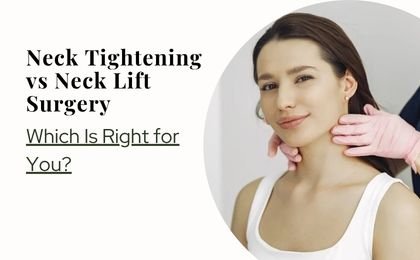
Neck Tightening vs Neck Lift Surgery: Understanding the Difference
Loose or crepey-looking neck skin can develop gradually with age, sun exposure, genetics, weight changes and changes in the tissues beneath the skin. For some people, the first concern is a softer jawline or fine horizontal lines. Others develop visible skin folds, jowls, under-chin fullness or vertical neck bands.
Both nonsurgical neck tightening treatments and neck lift surgery may improve the appearance of the neck, but they are designed to solve different levels of concern. Nonsurgical procedures generally provide more subtle improvement with less downtime, while surgery can physically remove and reposition tissue when significant laxity is present.
The best treatment to tighten neck skin therefore depends on what is actually causing the change. Mild laxity may respond to radiofrequency, ultrasound or another energy-based procedure. Crepey texture may require a resurfacing-focused approach. Significant excess skin or advanced structural sagging may be better addressed surgically.
For clients considering neck tightening in Los Angeles, a personalized consultation in Westwood can help separate skin laxity from fat, muscle bands and deeper structural changes. This allows clients from Beverly Hills, Brentwood, Santa Monica, Century City, Bel Air, Culver City and surrounding neighborhoods to choose treatment based on realistic results rather than simply selecting the procedure with the least downtime.
What Is Nonsurgical Neck Tightening?
Nonsurgical neck skin tightening refers to procedures designed to improve mild or moderate laxity without surgically removing skin.
Depending on the treatment, controlled energy or small needles may be used to create a biological response within the skin and underlying tissue. The goal may be firmer-looking skin, smoother texture, reduced fine lines or improved definition along the neck and jawline.
Common nonsurgical neck tightening procedures include:
- Non-invasive radiofrequency
- Focused ultrasound
- Traditional microneedling
- Radiofrequency microneedling
- Laser or other resurfacing treatments
- Carefully planned combination treatments
These procedures do not all work in the same way, and they should not be considered interchangeable.
What Is a Surgical Neck Lift?
A surgical neck lift, also known as lower rhytidectomy, is designed to improve visible aging of the jawline and neck by directly changing deeper tissue.
Depending on the anatomy and surgical plan, a surgeon may reposition tissue beneath the skin, tighten the platysma muscle, sculpt or redistribute fat, redrape the skin and remove excess skin. Traditional neck-lift incisions commonly extend around the ear and into the hairline, while a separate incision beneath the chin may sometimes be used for muscle repair or treatment of under-chin fat. Limited-incision procedures are possible for selected patients but generally provide more limited correction.
This is fundamentally different from nonsurgical tightening. A device can improve selected aspects of skin firmness, but it cannot physically trim away a substantial amount of loose skin.
Nonsurgical Neck Tightening vs Neck Lift: Quick Comparison
| Factor | Nonsurgical Neck Tightening | Surgical Neck Lift |
|---|---|---|
| Main goal | Improve mild laxity, texture or firmness | Correct significant skin and structural laxity |
| Incisions | Usually none | Yes |
| Excess skin removal | No | Yes |
| Muscle tightening | No direct surgical repair | May be performed |
| Under-chin fat | Limited depending on treatment | Can be addressed when appropriate |
| Degree of change | Usually subtle to moderate | More substantial |
| Recovery | Usually shorter | Longer |
| Maintenance | Often needed | Aging continues, but structural results may last longer |
| Best suited for | Early to moderate concerns | More advanced laxity or jowling |
When Is Nonsurgical Neck Tightening a Better Choice?
Nonsurgical treatment may be appropriate when the neck still has relatively good underlying structure and the primary concern is early skin looseness.
Mild Neck Laxity
If the skin has only recently begun to look less firm, an energy-based treatment may provide enough improvement without the need for surgery.
Non-invasive radiofrequency, for example, uses controlled energy to heat selected tissue and may make treated skin appear or feel tighter. Results and intended uses vary by the exact device.
Crepey-Looking Skin
Thin, finely wrinkled texture may benefit more from a treatment that focuses on skin quality.
Possible options include:
- Microneedling
- RF microneedling
- Laser resurfacing
- Other professionally selected resurfacing treatments
The best neck tightening treatment in this situation may not be the treatment that creates the strongest lift. Improving the surface texture can sometimes make a greater visible difference.
Fine Horizontal Neck Lines
Horizontal neck lines are not always caused by loose skin alone. Skin movement, genetics, posture and texture changes can contribute.
A personalized plan may include resurfacing, microneedling, professional skincare or another medical treatment rather than aggressive lifting.
Early Jawline Softness
When mild laxity is beginning to blur the jawline, nonsurgical tightening may help create a more refined transition from the lower face to the neck.
However, if the softness is primarily caused by jowls, under-chin fat or facial structure, tightening neck skin alone may produce limited improvement.
You Prefer Minimal Downtime
A major advantage of nonsurgical treatment is generally shorter recovery.
Depending on the procedure, temporary effects may include:
- Redness
- Warmth
- Swelling
- Tenderness
- Pinpoint marks
- Dryness
- Mild peeling
The exact recovery varies substantially by treatment intensity.
When Is Neck Lift Surgery a Better Choice?
Surgery may offer better value when the problem is too advanced for a nonsurgical device to correct meaningfully.
Significant Loose Neck Skin
A large fold or hanging area of skin cannot simply be tightened away with an external energy treatment.
Surgery allows excess skin to be physically removed and the remaining tissue to be repositioned.
Advanced Jowling
Jowls involve changes in deeper facial tissues as well as skin. A nonsurgical treatment may improve skin quality but cannot reproduce the structural repositioning achieved with surgery.
Prominent Neck Bands
Vertical neck cords often involve the platysma muscle. During neck lift surgery, the platysma can be tightened or repaired when appropriate.
A skin-only treatment may leave prominent muscle bands largely unchanged.
Loose Skin After Significant Weight Loss
People who have lost substantial weight may be left with more skin than a device can reasonably tighten.
Repeated nonsurgical sessions may cost considerable time and money while still failing to provide the degree of correction expected.
You Want a More Significant Change
Nonsurgical neck tightening treatments are generally better for subtle improvement.
If the goal is substantial contour change, significant skin removal or correction of advanced laxity, a surgical consultation may provide a more realistic pathway.
ASPS describes healthy nonsmokers without medical conditions that impair healing and with realistic expectations as typical candidates for neck lift surgery.
What Are the Best Nonsurgical Neck Tightening Procedures?
The best neck tightening procedures depend on what needs improvement.
Non-Invasive Radiofrequency
Radiofrequency may be considered for mild laxity and reduced firmness.
Treatment does not normally involve surgical incisions, making it appealing to people who want relatively limited downtime.
However, it cannot remove significant excess skin or surgically repair deeper structures.
Focused Ultrasound
Focused ultrasound delivers energy at selected depths beneath the skin.
It may be considered for early neck laxity or jawline softness when a surgical result is not required.
Improvement generally develops gradually rather than producing an immediate dramatic lift.
Traditional Microneedling
Traditional microneedling is more useful for:
- Fine lines
- Crepey texture
- General skin quality
- Selected superficial irregularities
It is not usually the best treatment to tighten neck skin when substantial sagging is present.
RF Microneedling
RF microneedling combines needle penetration with radiofrequency energy and may be considered when laxity occurs together with texture concerns.
However, this procedure requires particularly careful provider and device selection.
The FDA issued a safety communication in October 2025 after reports of serious complications associated with certain aesthetic uses of RF microneedling. Reported complications included burns, scarring, unwanted fat loss, nerve injury and disfigurement, with some cases requiring medical or surgical intervention.
RF microneedling should therefore be treated as a medical procedure, not as a routine facial service.
Laser Resurfacing
Laser treatment may offer more value when mild laxity occurs together with:
- Sun damage
- Rough texture
- Fine wrinkles
- Uneven pigmentation
- Crepey-looking skin
Different laser technologies have very different strengths, treatment depths and recovery periods. Asking for the exact device and expected downtime is more useful than simply asking whether a clinic offers “laser neck tightening.”
What If the Problem Is a Double Chin?
A double chin and loose neck skin are not the same thing.
Under-chin fullness may result from:
- Excess fat
- Loose skin
- Jaw structure
- Muscle anatomy
- A combination of these factors
Someone with good skin elasticity but significant fat may benefit from a different treatment than someone with little fat and substantial skin laxity.
When both fat and loose skin are present, treating only one problem can produce an incomplete result.
This is why the best neck tightening consultation should assess the entire neck and jawline rather than focusing only on the skin surface.
What If My Neck Has Vertical Bands?
Visible vertical cords are often associated with the platysma muscle.
Energy-based skin treatments may improve the overlying skin without fully correcting the underlying muscle activity.
Depending on severity, a provider may discuss:
- A muscle-directed injectable treatment
- Combination therapy
- Surgical platysma tightening
- Neck lift surgery
A treatment should be selected according to the structure causing the band rather than assuming every line is a skin wrinkle.
What If My Main Concern Is Neck Texture?
Someone with relatively firm skin but significant fine lines or sun damage may not need aggressive neck tightening.
Texture-focused treatment may be more appropriate.
Possible options include professional microneedling, laser resurfacing or another carefully selected skin procedure.
Microneedling temporarily disrupts the skin barrier, and the FDA notes that treated skin can become more sensitive to sunlight and certain skincare ingredients during recovery.
The treatment plan should therefore consider both the intended improvement and the aftercare required.
Neck Tightening Recovery vs Neck Lift Recovery
Recovery is one of the biggest differences between nonsurgical treatment and surgery.
After Nonsurgical Neck Tightening
Depending on the procedure, you may experience:
- Redness
- Mild swelling
- Warmth
- Tightness
- Tenderness
- Dryness
- Pinpoint marks after needle-based procedures
- Peeling after resurfacing
Some treatments allow a relatively quick return to work and social activity, while more intensive procedures require several days of visible healing.
After Neck Lift Surgery
Surgical recovery is more involved.
Bandages may be placed around the neck and face to help manage bruising and swelling, and a temporary drain may sometimes be used to prevent fluid accumulation. Patients receive individualized instructions about wound care, medications and follow-up.
ASPS advises keeping the head elevated and avoiding excessive twisting or bending of the neck during early recovery.
Patients should not independently apply treatments, massage, heat, cold or skincare products to surgical areas unless directed by their surgeon.
Risks: Nonsurgical Neck Tightening vs Surgery
No medical cosmetic procedure is risk-free.
Nonsurgical Treatment Risks
Depending on the technology, complications can include:
- Prolonged redness
- Swelling
- Burns
- Blisters
- Pigmentation changes
- Scarring
- Infection
- Uneven texture
- Persistent pain
- Unwanted volume loss
- Nerve injury
The exact risk profile varies by device.
Neck Lift Surgery Risks
Possible surgical risks include:
- Anesthesia complications
- Bleeding
- Fluid accumulation
- Infection
- Numbness or altered sensation
- Persistent pain
- Poor wound healing
- Prolonged swelling
- Skin irregularity or discoloration
- Unfavorable scarring
- Skin loss
- Asymmetry
- Rare nerve injury causing lower-lip weakness
- Need for revision surgery
These risks should be discussed directly with the surgeon before informed consent.
Preparing for Neck Lift Surgery
Surgical preparation may include medical evaluation, laboratory testing, medication review and smoking cessation.
A surgeon may also instruct a patient to avoid certain medications or supplements that can increase bleeding. Medication changes should always be coordinated with the prescribing clinician rather than made independently.
Neck lift surgery may be performed in an accredited office-based surgical facility, licensed ambulatory surgical center or hospital. Outpatient patients generally need transportation home and someone to stay with them during the initial recovery period.
Who Should Avoid or Postpone Neck Tightening?
Treatment may need to be postponed or modified if you have:
- Active skin infection
- Open wounds
- Significant sunburn
- Active inflammatory skin disease
- Poorly controlled diabetes
- Impaired wound healing
- Untreated bleeding problems
- Significant immune suppression
- Recent surgery in the area
- Recent aggressive resurfacing
- Suspicious skin lesions
- Medication that has not been medically reviewed
- Unrealistic expectations
Certain energy-based procedures may also be unsuitable for people with specific implanted medical devices or metal near the treatment area.
Pregnancy and breastfeeding should always be disclosed before elective aesthetic treatment.
How Long Do Neck Tightening Results Last?
No treatment permanently stops the aging process.
Longevity depends on:
- Procedure type
- Age
- Genetics
- Skin quality
- Sun exposure
- Weight changes
- Smoking
- Lifestyle
- Maintenance
- Treatment intensity
Nonsurgical procedures may require maintenance as skin continues changing.
A surgical neck lift can provide a more durable structural correction, but natural aging still continues after surgery.
Solutions for Common Neck Tightening Problems
“I Had Neck Tightening but I Still Have Loose Skin”
Allow enough time for the full result to develop. If significant laxity remains after appropriate healing, the underlying issue may simply be too advanced for the procedure.
A surgical consultation may provide more useful information than automatically repeating the same treatment.
“My Neck Is Firmer but My Double Chin Is Still There”
The original concern may involve fat rather than skin alone.
Ask for a separate assessment of under-chin fat, jaw structure and skin laxity.
“My Skin Looks Better, but Neck Bands Remain”
The bands may be muscular. Skin resurfacing or tightening will not necessarily correct them.
“I Want Results Without Any Downtime”
Minimal downtime usually means accepting more modest improvement.
More aggressive treatments typically involve greater healing. Choosing a procedure solely because it promises zero recovery may lead to unrealistic expectations.
“I Want Surgical Results Without Surgery”
Nonsurgical treatment cannot reproduce surgical tissue removal and repositioning.
When the desired result requires significant structural correction, multiple nonsurgical sessions may still fall short.
Choosing Neck Tightening in Los Angeles
California treats procedures involving medical lasers and other medical-level aesthetic treatments as the practice of medicine. The Medical Board of California advises patients to verify who is performing a procedure, what license they hold and whether they have appropriate training and supervision.
Before booking neck tightening in Los Angeles, ask:
- What is causing my neck concern?
- Is the problem skin, fat, muscle or several factors?
- Which procedure do you recommend?
- Why is it preferable to the alternatives?
- What exact device will be used?
- Who will perform my treatment?
- What professional license do they hold?
- What degree of improvement is realistic?
- How much downtime should I expect?
- What complications can occur?
- How are complications managed?
- When should I consider surgical consultation?
If surgery is recommended, ASPS advises asking about board certification, facility accreditation, technique, recovery, risks, complication management and realistic results.
A Westwood consultation can be convenient for Century City professionals planning around work, Santa Monica clients considering sun exposure during recovery, and residents of Beverly Hills, Brentwood, Bel Air or Culver City who want to compare surgical and nonsurgical options.
Frequently Asked Questions
What Is the Best Neck Tightening Treatment?
The best neck tightening treatment depends on the severity and cause of your concern. Mild laxity may respond to RF or ultrasound, texture concerns may benefit from microneedling or resurfacing, and significant loose skin may require surgical evaluation.
What Is the Best Treatment to Tighten Neck Skin Without Surgery?
For selected mild laxity, non-invasive radiofrequency or focused ultrasound may be considered. The appropriate option depends on your anatomy, skin condition, medical history and expected result.
Is Neck Skin Tightening Better Than a Neck Lift?
Neither is universally better. Nonsurgical neck skin tightening offers less downtime and more subtle improvement, while a neck lift can provide greater structural correction for advanced laxity.
Can Neck Tightening Remove Loose Skin?
Nonsurgical treatments may improve mild looseness but do not physically remove excess skin. A surgical neck lift can remove and redrape skin when necessary.
What Are the Best Neck Tightening Procedures for Crepey Skin?
Microneedling, RF microneedling and laser resurfacing may be considered when fine lines and texture are prominent. The best choice depends on skin condition and acceptable recovery.
Can Neck Tightening Fix a Double Chin?
Only when laxity is an important part of the problem. Significant under-chin fat may require a separate treatment approach.
Can Neck Tightening Remove Vertical Neck Bands?
Skin-focused treatments may have limited effect when bands are primarily caused by the platysma muscle. Muscle-directed treatment or surgery may be considered instead.
How Many Neck Tightening Treatments Will I Need?
The number depends on the technology and treatment response. Some procedures are performed as a series, while others begin with one session followed by several weeks or months of observation.
Does Neck Lift Surgery Last Forever?
No. Surgery can create longer-lasting structural correction, but natural aging continues and the neck will gradually change over time.
Where Can I Compare Neck Tightening Treatments in Los Angeles?
A personalized Westwood consultation can help clients from Beverly Hills, Brentwood, Santa Monica, Century City, Bel Air, Culver City and nearby Los Angeles neighborhoods compare nonsurgical neck tightening treatments with surgical options.
Choose the Right Level of Neck Correction
The best neck tightening approach is the one that matches the actual severity of your concern. Mild laxity and texture changes may respond well to nonsurgical treatment, while substantial loose skin, advanced jowling or prominent neck bands may require surgical evaluation for meaningful correction.
Book a personalized Westwood consultation to compare neck tightening procedures, expected results, recovery, risks and surgical versus nonsurgical options before choosing your treatment.
Book Your Free Consultation
Get expert advice and a personalized treatment plan—no commitment required