
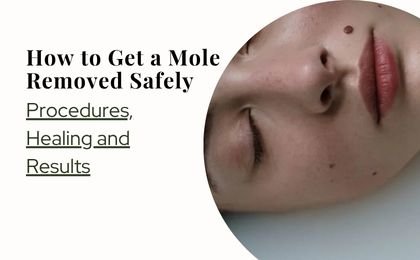
Moles are common skin growths that may be flat, raised, skin-colored, brown, black, pink or another shade. Many remain stable for years and do not require treatment. Others become irritated by clothing or shaving, affect someone’s confidence, or develop changes that require medical examination.
The correct approach to mole removal begins with diagnosis. A clinician should determine whether the growth appears to be a common benign mole, another type of skin lesion, or something that requires biopsy. Removing an undiagnosed growth with chemicals, heat or an at-home device can damage the skin while delaying the diagnosis of skin cancer.
A professional consultation is particularly important for facial mole removal. The face contains delicate structures and highly visible contours, so the removal method, wound closure, pathology needs and likely scar must all be considered before treatment.
For clients considering mole removal in Los Angeles, a Westwood consultation provides convenient access from Beverly Hills, Brentwood, Santa Monica, Century City, Bel Air, Culver City and nearby communities. The objective should be medically appropriate removal with realistic expectations—not simply eliminating the visible spot as quickly as possible.
Can You Remove a Mole?
Yes, many moles can be removed by a qualified medical professional. A dermatologist may recommend removal when a mole is physically bothersome, cosmetically unwanted or suspicious for skin cancer.
Common medical removal methods include surgical shave removal and surgical excision. In both methods, the removed tissue can usually be examined under a microscope when appropriate. Most routine procedures can be completed during an office visit, although follow-up may be required for pathology results, suture removal or additional care.
The answer to can you remove a mole therefore depends on more than whether removal is technically possible. The clinician must also consider:
- What type of growth it is
- Whether it has changed
- Its depth and diameter
- Its location
- Whether pathology is needed
- Your healing and scarring history
- The cosmetic importance of the area
- Whether removal could interfere with nearby structures
A mole near the eyelid, lip, nose or another sensitive facial location may require different planning from a mole on the back or shoulder.
When Should a Mole Be Checked Before Cosmetic Removal?
A new, changing or unusual mole should be evaluated before any cosmetic destruction is considered.
Dermatologists often use the ABCDE guide when assessing pigmented spots:
A—Asymmetry: One side differs from the other.
B—Border: The edge is irregular, poorly defined or uneven.
C—Color: The growth contains different colors or uneven pigmentation.
D—Diameter: Melanomas are often larger than 6 millimeters when found, but they may also be smaller.
E—Evolving: The spot changes in size, shape, color or appearance.
A mole that itches, hurts, bleeds, grows, looks different from your other spots or develops a sore should also receive prompt medical attention. These signs do not automatically mean cancer, but they should not be ignored or covered by a cosmetic treatment.
Arrange Medical Evaluation Promptly When a Mole:
- Appears suddenly or grows quickly
- Changes color or develops several colors
- Has an irregular or blurred border
- Becomes painful or persistently itchy
- Bleeds without being injured
- Repeatedly crusts or forms a sore
- Looks noticeably different from your other moles
- Returns after previous removal
When a lesion is suspicious, the priority is diagnosis. A skin biopsy allows removed tissue to be examined by a dermatopathologist, who reports whether further treatment is necessary.
How to Get a Mole Removed
The safest answer to how to get a mole removed is to schedule an examination with a qualified dermatologist or medical professional experienced in skin lesions.
Step 1: Consultation and Medical History
The appointment should begin with questions about:
- How long the mole has been present
- Whether it has changed
- Bleeding, itching or pain
- Previous mole removal
- Personal or family history of skin cancer
- Current medication
- Blood-thinning treatment
- Allergies
- Pregnancy or breastfeeding
- Diabetes or immune conditions
- Previous wound-healing problems
- Keloid or raised-scar history
- Previous pigment changes after an injury
Do not stop blood thinners or other prescription medication without instructions from the clinician who prescribed them.
Step 2: Examination
The clinician examines the mole’s size, shape, surface, color, border and surrounding skin. A dermatoscope may be used to examine features not easily seen with the unaided eye.
The assessment helps determine whether the lesion can be observed, removed cosmetically, shaved, completely excised or biopsied.
Step 3: Selecting the Mole Removal Procedure
The recommended mole removal procedure depends on the lesion’s appearance, depth, location and medical significance.
The provider should explain:
- Why a particular method is recommended
- Whether stitches will be needed
- Whether the specimen will be sent to a laboratory
- The possibility of recurrence
- Expected wound size
- Scar location and appearance
- Healing time
- Total estimated cost
Step 4: Local Anesthetic
For many office-based procedures, local anesthetic is injected around the mole. The injection may briefly sting, after which the area should become numb.
You may still feel pressure or movement, but significant sharp pain should be reported immediately.
Step 5: Removal and Wound Care
The clinician removes the mole using the planned technique, controls bleeding and dresses or closes the wound. You should receive written instructions explaining cleansing, dressing changes, activity restrictions, warning signs and follow-up.
Surgical Shave Mole Removal
A surgical shave is commonly considered for suitable raised moles. The clinician uses a sterile blade to remove the growth at or close to the surrounding skin level.
Potential Advantages
- Often completed during an office appointment
- May not require stitches
- Useful for selected raised moles
- Tissue can generally be sent for laboratory examination
- May involve a smaller wound than complete excision
Limitations
A shave procedure may not remove every mole cell beneath the surface. The mole can therefore recur or leave residual pigmentation.
The healing area may also become lighter, darker, slightly indented or raised. A perfectly invisible result cannot be guaranteed.
Shave removal should not be confused with shaving a mole at home. Dermatologists use sterile instruments, bleeding control, appropriate anesthesia and medical judgment to reduce avoidable risks. AAD specifically advises against cutting or shaving off a mole yourself because of the risks of cancer being left behind, infection and permanent scarring.
Mole Removal Surgery: Surgical Excision
Mole removal surgery usually refers to surgical excision. The clinician removes the visible mole and an appropriate depth of tissue. The wound is then closed with stitches when necessary.
Excision May Be Recommended When:
- The mole extends deeper into the skin
- Complete removal is preferred
- The lesion has suspicious features
- An intact specimen is needed
- The mole returned after a previous shave
- Its size or location makes excision more appropriate
Surgical excision may create a longer linear scar than shave removal because the edges must be brought together. However, it may offer a lower chance of visible recurrence when the full mole is removed.
The phrase removing mole surgery is sometimes used online, but “surgical excision” is the clearer medical description.
Will the Tissue Be Tested?
A removed mole is often sent to a laboratory, particularly when there is any diagnostic uncertainty. A dermatopathologist examines the tissue microscopically and provides a report to the treating clinician. Additional surgery or surveillance may be required when abnormal cells are identified.
Facial Mole Removal
The removal of moles on face areas requires detailed planning because even a small scar may be noticeable.
A mole on face removal consultation should consider:
- The mole’s medical appearance
- Its depth and width
- Facial skin thickness
- Natural creases and contour lines
- Proximity to the eyes, nose, lips or hairline
- The direction of wound closure
- Your tendency toward dark marks or raised scars
- Whether pathology is necessary
- The possibility of recurrence
A stable raised cheek mole may be suitable for a different method than a flat pigmented mole near the eyelid. There is no single technique that provides the best mole removal result for every facial location.
Does Mole Removal on the Face Leave a Scar?
Any procedure that breaks the skin can leave a scar. The aim is to choose a method and wound closure that allow the area to heal as neatly as possible.
Early scars may look pink, red, brown, firm or slightly raised. They usually change gradually over several months. Sun protection after the wound closes can help reduce persistent discoloration and support scar fading.
Someone seeking mole removal on face areas should be cautious of promises such as “scarless,” “zero mark” or “guaranteed invisible healing.”
Laser Surgery for Moles
Laser surgery for moles is often promoted as a fast, scar-free alternative, but it is not the correct method for every pigmented lesion.
Laser energy destroys targeted tissue. When a lesion is destroyed rather than surgically removed, an intact specimen may not remain available for complete microscopic examination. For this reason, laser treatment should not be used to bypass medical diagnosis or pathology when a mole is suspicious or uncertain.
A dermatologist may discuss laser or another device for a carefully diagnosed benign lesion in selected circumstances. Before proceeding, ask:
- Has the lesion been medically identified?
- Why is laser preferred over shave or excision?
- Will tissue be available for pathology?
- What is the recurrence risk?
- Could treatment cause light or dark marks?
- How many sessions may be required?
- What happens if pigment returns?
The words “laser” and “surgery” do not automatically mean a better cosmetic result. The best method depends on medical safety, lesion type and expected healing.
How to Get Moles Removed When There Are Several
For multiple moles removal, each growth should be examined separately. Similar-looking spots may have different diagnoses, depths and risk features.
A clinician may recommend:
- Removing several suitable benign moles during one visit
- Staging treatment to make wound care easier
- Biopsying one or more suspicious lesions
- Monitoring stable moles rather than removing all of them
- Referring a delicate facial location to another specialist
- Creating a skin-surveillance plan
People with many moles may benefit from regular skin examinations based on their individual risk. The AAD notes that having 50 or more moles is associated with increased melanoma risk and may justify dermatologist-directed monitoring.
Mole Removal Healing Timeline
Healing varies according to the procedure, wound depth, use of stitches, body location, health and aftercare.
First 24–72 Hours
The area may appear pink or red and feel tender. Mild swelling, bruising or a small amount of spotting on the dressing can occur.
Follow the clinician’s instructions about keeping the initial dressing in place.
Days 3–10
The wound begins closing. Mild itching may occur, but scratching or picking can reopen the area.
Many small biopsy wounds heal in about seven to ten days, although wounds on the lower legs, deeper excisions and stitched sites may require more time.
Weeks 2–6
The surface may be closed while the new scar remains visible. Redness, firmness, sensitivity or pigmentation can continue.
Sutures should be removed according to the clinician’s schedule rather than at home.
Following Months
The scar gradually matures. It may soften, flatten and become less noticeable, but the final appearance can take months.
Arrange reassessment if pigment or a growth returns at the removal site. AAD recommends seeing a dermatologist promptly when a removed mole grows back.
Mole Removal Aftercare
Your provider’s instructions should take priority because wound care can vary by procedure.
General care commonly includes:
- Wash your hands before touching the area.
- Remove the dressing gently when instructed.
- Clean the wound with mild soap and water.
- Avoid scrubbing.
- Pat the surrounding skin dry.
- Apply approved petroleum jelly.
- Cover the area with a clean non-stick dressing.
- Change the dressing as directed.
- Avoid swimming and hot tubs until the wound has healed.
- Attend pathology and suture-removal appointments.
Dermatology guidance supports keeping many small wounds clean, moist with petroleum jelly and covered. Routine topical antibiotic ointment is often unnecessary unless specifically prescribed, because it can cause allergic irritation in some people.
When to Contact the Clinic
Seek medical advice for:
- Bleeding that continues despite firm pressure
- Increasing rather than improving pain
- Spreading redness
- Worsening swelling or warmth
- Pus or unusual drainage
- Fever
- Wound separation
- An allergic reaction
- A new or returning pigmented growth
Why You Should Never Remove a Mole at Home
There is no safe best mole remover for unsupervised home use.
Cutting, burning, freezing or applying acid to a mole can:
- Cause infection
- Produce an uncontrolled chemical burn
- Create a permanent scar
- Leave mole cells beneath the skin
- Make future diagnosis more difficult
- Delay recognition of skin cancer
- Damage healthy tissue around the mole
The FDA states that no over-the-counter drug can legally be marketed for mole or skin-tag removal. It has warned that products sold for these purposes can cause injury and scarring and may delay diagnosis of a potentially cancerous lesion.
Wart-removal liquids should also never be applied to a mole. A wart and a mole are different types of growths and require different evaluation.
Mole Removal Cost
Mole removal cost varies according to:
- Number of moles
- Facial or body location
- Size and depth
- Shave removal or excision
- Need for stitches
- Provider qualifications
- Pathology fees
- Facility charges
- Follow-up visits
- Scar-care needs
- Insurance status
Cosmetic removal is commonly self-pay. Evaluation, biopsy or treatment may be handled differently when the lesion is medically suspicious or repeatedly symptomatic. Coverage depends on the insurance policy and medical documentation.
When comparing mole removal Los Angeles CA providers, request a written estimate clarifying whether consultation, pathology, follow-up and suture removal are included.
The cheapest quote is not necessarily the best value. A low-cost service that skips diagnosis, pathology or follow-up may expose you to avoidable medical and cosmetic risks.
Frequently Asked Questions
Can You Remove a Mole During the First Appointment?
Many suitable moles can be removed during an office visit, but same-day treatment is not guaranteed. A suspicious lesion, complex facial location, medication issue or need for a different specialist may require additional planning.
How to Get a Mole Removed From the Face?
Schedule a medical assessment for facial mole removal. The clinician will determine whether shave removal, surgical excision, biopsy, observation or another option is most appropriate.
What Is the Best Mole Removal Procedure?
The best mole removal method depends on the mole’s diagnosis, depth, size, location and need for pathology. Shave removal may suit certain raised benign moles, while excision may be preferred for deeper or suspicious lesions.
Is Mole Removal Surgery Painful?
Local anesthetic is commonly used. You may feel a brief sting during the injection and pressure during the procedure. Mild soreness can occur after the anesthetic wears off.
Can Laser Surgery for Moles Prevent Scarring?
No method can promise scar-free healing. Laser can cause pigmentation changes, texture changes or scarring and may not provide tissue for pathology. It should be considered only after medical diagnosis.
Can a Mole Grow Back?
Yes. Recurrence can occur when mole cells remain beneath the skin, particularly after a superficial procedure. A returning mole should be medically reassessed.
How Long Does Facial Mole Removal Take to Heal?
A small surface wound may close within approximately one to two weeks, while deeper excisions and stitched wounds can take longer. Scar color and firmness may continue changing for several months.
What Is the Best Mole Remover for Home Use?
There is no medically recommended home mole remover. FDA warnings explain that over-the-counter mole-removal products are not legally marketed for this purpose and can cause injury or delay diagnosis.
How Much Does Mole Removal Cost?
Pricing depends on the procedure, number and location of moles, pathology, stitches and follow-up. A medical consultation is necessary for an accurate quote.
Where Can I Discuss Mole Removal in Los Angeles?
A Westwood consultation is convenient for clients seeking mole removal in Los Angeles from Beverly Hills, Brentwood, Santa Monica, Century City, Bel Air, Culver City and nearby neighborhoods.
Schedule a Professional Mole Evaluation
Safe mole removal begins with confirming what the growth is and selecting a procedure that supports both diagnosis and appropriate cosmetic healing.
Book a Westwood consultation to discuss the removal method, pathology, scar expectations, aftercare and complete mole removal cost.
Book Your Free Consultation
Get expert advice and a personalized treatment plan—no commitment required