Professional eyebrow threading can make a noticeable difference without dramatically changing your natural brows. By removing selected hairs from around the brow line, threading creates cleaner edges, improves the visibility of the arch, and gives the brows a more balanced appearance.
The most successful eyebrow threading before and after results do not necessarily show thinner or sharply sculpted brows. Instead, they show how careful hair removal can preserve natural fullness while improving shape and definition.
Results vary according to natural brow density, facial structure, hair-growth direction, previous tweezing, and personal style. Someone with thick brows may need only light cleanup, while a person with uneven regrowth may benefit from more detailed shaping.
Beverly Microblading Center provides customized eyebrow threading in Los Angeles from its Westwood studio. Clients from Beverly Hills often request refined, softly shaped brows, while Century City professionals appreciate efficient appointments that fit into a busy schedule. Brentwood, Santa Monica, Bel Air, Culver City, and nearby neighborhoods are also conveniently served.
This guide explains what brows may look like before and after threading, how the service works, how long results last, what aftercare is needed, and how to address common concerns.
What Is Eyebrow Threading?
Eyebrow threading is a precise method of removing unwanted hair with a twisted cotton thread.
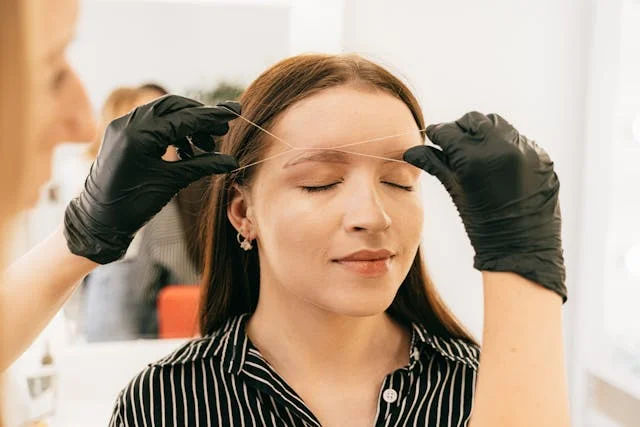
The technician moves the twisted section of thread across the skin, capturing hairs and lifting them from the follicle. The technique can remove narrow rows of fine hair or target individual hairs around the brow.
Threading is commonly used to refine:
- The area between the brows
- The lower brow line
- The upper brow line
- The arch
- The brow tail
- Fine hairs around the temples
- Small areas requiring detailed correction
Because the hairs are removed from the follicle rather than cut at the surface, the results usually last longer than brow shaving.
Threading does not permanently stop hair growth. New hairs gradually appear as the natural growth cycle continues.
What Do Brows Look Like Before Threading?
Before threading, the brow area may have:
- Fine hairs beneath the brow
- Regrowth between the brows
- Uneven upper lines
- Overgrown tails
- A less visible arch
- Differences in brow width
- Hairs growing outside an established shape
- Unwanted growth around healed permanent makeup
- Areas affected by home tweezing
- Long hairs that require conservative trimming
Some brows look uneven because one side grows faster than the other. Others appear less defined because fine surrounding hairs soften the outline.
A professional technician should assess whether the concern is caused by unwanted growth, actual brow asymmetry, sparse hair, or hair direction. Threading removes hair but does not add color, create new hairs, or permanently redirect remaining brow hairs.
What Do Brows Look Like After Threading?
Immediately after professional threading, the brows generally appear:
- Cleaner around the edges
- More defined through the arch
- Better balanced
- Neater between the brows
- More controlled through the tails
- Easier to style
- Smoother around the surrounding skin
- Polished without appearing over-shaped
The brow body should still look full when a natural result is requested.
Professional eyebrow threading before after results may also make brow makeup easier to apply. Pencil, powder, gel, tint, or henna can follow a cleaner outline with greater accuracy.
Mild redness or small raised follicles may be visible immediately after the appointment. These effects are usually temporary and begin settling within several hours.
What Creates the Best Before-and-After Result?
A good result depends on much more than removing visible stray hairs.
Clear Communication
Your technician should know whether you prefer:
- Minimal cleanup
- A natural shape
- A defined arch
- Thick brows
- Fuller fronts
- Shorter tails
- A softer upper line
- Maintenance of an existing design
Major changes should be discussed before significant hair is removed.
Conservative Hair Removal
Useful brow hairs should be preserved, especially when the brows are sparse or being grown out after over-tweezing.
Removing too much from the lower line may create an exaggerated arch. Excessive removal from the upper line can change the brow’s natural expression.
Understanding Natural Asymmetry
Natural brows are rarely identical. One may sit higher, contain more hair, or have a different arch.
The goal should be visual balance rather than forcing both brows into exactly the same measurements.
Facial Proportion
The brow shape should complement the forehead, eye position, brow bone, and overall face.
A shape that looks attractive on one person may not suit another.
Brow-Hair Direction
Hairs may grow upward, downward, or diagonally. Threading removes unwanted hairs but does not permanently reposition the hairs that remain.
Brow lamination may be considered when unruly direction is the main concern.
Natural Eyebrow Threading vs Highly Defined Shaping
Natural eyebrow threading focuses on maintaining the existing brow thickness while cleaning unwanted growth around it.
This style may include:
- Minimal upper-line removal
- Gentle lower-line cleanup
- Preservation of fuller fronts
- Conservative tail shaping
- Soft arch refinement
- Little or no trimming
A highly defined shape may involve more detailed removal around the arch and lower brow line.
Neither approach is universally better. The right choice depends on your features, natural growth, makeup style, and maintenance preferences.
Westwood and Brentwood clients often prefer natural shaping that looks polished every day. Beverly Hills and Bel Air visitors may request more refined definition, while Santa Monica and Culver City clients may choose a softer shape that works well with minimal makeup.
The Eyebrow Threading Process
Consultation
The appointment begins with a brief discussion of your preferred shape and brow concerns.
Tell the technician if you:
- Are growing out specific areas
- Have previously over-tweezed
- Want to preserve thickness
- Have healed permanent makeup
- Use active skincare
- Recently had a facial treatment
- Have experienced irritation after hair removal
Brow Assessment
The technician examines:
- Natural density
- Existing shape
- Brow starting points
- Arch placement
- Tail length
- Hair-growth direction
- Areas of regrowth
- Natural asymmetry
- Skin condition
This assessment determines which hairs should remain.
Cleansing
Makeup, sunscreen, oil, and skincare residue are gently removed.
Arriving with clean brows can help the thread grip fine hairs more effectively.
Shape Planning
The technician evaluates both brows from the front and side.
The design may focus on maintaining the existing shape or creating a new, more balanced outline.
Skin Positioning
The skin needs to remain firm while the thread moves across it. You may be asked to hold the skin gently above or below the brow.
Keeping the area taut helps the technician work more accurately.
Hair Removal
The twisted cotton thread captures unwanted hairs and lifts them from the follicle.
The technician may work through the area between the brows, lower line, upper line, arch, and tails.
Symmetry Check
Both brows are reviewed repeatedly.
A professional service should not wait until the end to compare the shape.
Detailed Refinement
Tweezers may be used for isolated hairs. Long brow hairs may also be trimmed carefully when necessary.
Over-trimming can create blunt sections and make the brows appear less full, so it should remain conservative.
Final Styling
Loose hairs are removed, and the brows are brushed into position.
A soothing product may be applied when appropriate for the skin.
How Long Does Eyebrow Threading Take?
Most appointments take approximately 10–25 minutes.
Treatment time varies according to:
- Natural brow density
- Amount of regrowth
- Desired shape
- Existing asymmetry
- Makeup removal
- Previous over-tweezing
- Additional tweezing
- Trimming
- First-time shaping or routine maintenance
A detailed first appointment may take longer than a regular cleanup because the technician needs to assess your features and discuss the desired shape.
Does Eyebrow Threading Hurt?
Threading can create a brief pulling, pinching, or stinging sensation as the hairs are removed.
Sensitivity varies based on:
- Personal pain tolerance
- Hair thickness
- Skin condition
- Amount of regrowth
- Recent exfoliation
- Hormonal changes
- Treatment area
- Technician technique
The area below the arch may feel more sensitive than the upper brow line.
Discomfort usually ends quickly after the hair removal is complete. Mild redness or warmth may remain temporarily.
Eyebrow Threading Results Timeline
Immediately After Treatment
The brows look cleaner and more defined. Mild redness, warmth, or raised follicles may be visible.
Avoid repeatedly touching the freshly threaded skin.
First 2–6 Hours
Redness usually begins to settle. Keep makeup, heavy skincare, heat, and sweat away from the area.
First 24–48 Hours
The skin should gradually return to its normal appearance.
Avoid strong acids, retinoids, scrubs, and fragranced products if sensitivity remains.
Weeks 1–2
The brow shape remains clean and easy to maintain. A few fine hairs may begin appearing depending on your growth cycle.
Weeks 2–4
Regrowth becomes more visible around the edges. Many clients schedule their next appointment during this period.
How Long Does Eyebrow Threading Last?
Threaded brows generally remain clean and defined for approximately two to four weeks.
The exact duration depends on:
- Natural hair-growth speed
- Brow density
- Hormonal factors
- Age
- Previous hair-removal habits
- Individual follicle cycles
- Preferred level of definition
- Home tweezing
Not every hair grows at the same time. A few hairs may become visible within one or two weeks, while other areas remain clean for longer.
Someone who prefers a highly defined outline may book more frequently than someone comfortable with a softer grow-out.
Eyebrow Threading Aftercare
Proper aftercare helps reduce temporary redness and irritation.
For the first several hours:
- Avoid touching or rubbing the brow area
- Keep makeup away from freshly threaded skin
- Avoid heavy exercise and sweating
- Avoid saunas, steam rooms, and very hot showers
- Do not apply fragranced or alcohol-heavy products
- Avoid retinoids, scrubs, and exfoliating acids
- Do not tweeze repeatedly over irritated skin
Once the redness has settled, cleanse the area gently and return to your normal routine carefully.
A fragrance-free, non-comedogenic soothing product may be used when appropriate for your skin.
Protect the area from excessive sun exposure. Contact the studio if redness, itching, bumps, or swelling last longer than expected.
Seek medical care for severe pain, spreading redness, discharge, or signs of infection.
Can You Wear Makeup After Eyebrow Threading?
It is best to avoid applying makeup directly over freshly threaded skin for several hours or until redness has settled.
Products such as foundation, concealer, brow pomade, and powder may introduce oil, fragrance, or bacteria to recently treated follicles.
Once the skin feels calm, makeup can usually be applied gently.
Use clean brushes and avoid aggressive rubbing during removal.
Eyebrow Threading vs Waxing
Both treatments remove hair from the follicle, but they work differently.
Threading
Threading:
- Uses twisted cotton thread
- Allows precise hair selection
- Does not require heat
- Does not apply wax to the skin
- Can target fine hairs
- Supports conservative shaping
- May cause temporary redness
Waxing
Waxing:
- Removes broader sections quickly
- Uses warm or room-temperature wax
- Pulls across the skin surface
- Can create clean lines efficiently
- Requires caution with retinoids
- May irritate sensitized skin
- Is useful for larger areas
Threading may be preferred when precision is the priority or when someone wants to avoid wax.
Waxing may be suitable when a larger amount of hair needs to be removed quickly and the skin can tolerate the product.
Eyebrow Threading vs Tweezing
Tweezing removes one hair at a time.
It works well for minor maintenance but may be slower when many fine hairs need to be removed.
Threading can remove a narrow row of hairs more efficiently while preserving the main brow shape.
Threading may be preferable for full shaping, while tweezing may be helpful for one or two isolated hairs between appointments.
Repeated home tweezing can gradually alter the shape. Avoid removing hairs from the main brow body unless you are certain they fall outside the established design.
Eyebrow Threading vs Brow Shaving
Brow shaving cuts hair at the surface. Regrowth may appear sooner because the hair was not removed from the follicle.
Threading pulls the full hair from the root, usually creating a longer-lasting clean appearance.
Shaving may be useful for temporary surface removal, while threading offers more precise professional shaping and slower visible regrowth.
Common Eyebrow Threading Concerns and Solutions
Redness After Threading
Temporary redness is common.
Avoid heat, sweat, makeup, and strong skincare until the area settles. Do not rub or scratch the skin.
Small Bumps Around the Brows
Raised follicles may occur temporarily.
Keep the area clean and avoid heavy creams, makeup, or picking. Persistent or worsening bumps should be evaluated.
Brows Look Too Thin
Hair removed during threading cannot be restored immediately.
Avoid additional tweezing and allow the area to grow. Pencil, powder, tint, or henna may help improve the appearance while the hairs return.
Brows Look Uneven
Natural asymmetry, redness, and hair direction may affect how the brows look immediately after treatment.
Review the result after the skin has settled and contact the studio before removing more hair at home.
The Arch Looks Too High
A strong arch may be softened temporarily with brow makeup while hair grows back.
Future appointments should preserve more hair beneath or around the arch.
Hair Grew Back Quickly
Hair growth varies. Some clients naturally need maintenance every two weeks.
A more frequent schedule may be appropriate if a clean outline is important to you.
The Skin Feels Irritated
Sensitivity may be increased by retinoids, acids, sun exposure, recent peels, or active skin conditions.
Allow the skin to recover and disclose these products before your next appointment.
Threading Missed Fine Hairs
Extremely short or slippery hairs may be difficult to capture.
A few remaining hairs may be removed with sanitized tweezers when the skin is calm.
Eyebrow Threading Cost
The eyebrow threading cost varies according to:
- Salon location
- Technician experience
- Appointment duration
- Amount of regrowth
- Shape correction
- Additional tweezing
- Conservative trimming
- Combined brow services
- Studio standards
A maintenance cleanup may cost differently from a full reshaping appointment.
When comparing a salon for eyebrow threading, confirm whether the service includes consultation, threading, tweezing, trimming, soothing care, final styling, and aftercare instructions.
The lowest price may not provide the best value. Removing the wrong hairs can affect the brow shape for several weeks or longer.
How Often Should You Schedule Threading?
Most clients return every two to four weeks.
Regular appointments can help:
- Preserve the established shape
- Reduce home over-tweezing
- Keep the arch visible
- Maintain clean tails
- Support brow regrowth
- Reduce the amount removed during each appointment
Century City clients may choose regular appointments around work schedules, while Beverly Hills and Bel Air visitors may book before events. Westwood, Brentwood, Santa Monica, and Culver City clients can adjust their maintenance timing according to personal growth patterns.
What Makes a High-Quality Threading Result?
The best eyebrow threading result should look balanced, comfortable, and appropriate for your features.
A skilled technician should:
- Ask about your preferred thickness
- Preserve areas being grown out
- Avoid excessive front-brow removal
- Review both brows throughout the service
- Trim conservatively
- Adjust for natural asymmetry
- Explain what threading can and cannot correct
- Recommend a realistic maintenance schedule
Perfect eyebrow threading should not mean forcing both brows to look artificially identical. It should create a cleaner, more harmonious appearance while preserving natural character.
How to Choose an Eyebrow Threading Studio
A professional eyebrow threading studio should provide clear communication, careful shaping, and consistent sanitation.
Review the studio’s work for:
- Natural brow results
- Thick-brow maintenance
- Defined arches
- Conservative shaping
- Balanced tails
- Brow grow-out results
- Before-and-after photographs
- Work on different facial structures
Ask whether the technician will confirm your desired thickness and shape before removing hair.
When comparing the best eyebrow threading Los Angeles options, also consider convenience because threading is usually a recurring service. A Westwood location can make maintenance easier for clients from Beverly Hills, Brentwood, Santa Monica, Century City, Bel Air, and Culver City.
Who Should Postpone Eyebrow Threading?
Threading should generally be postponed when you have:
- Open cuts or sores
- Active eczema or dermatitis
- Psoriasis in the treatment area
- A skin infection
- Sunburn
- Significant peeling
- Inflamed acne directly around the brows
- Recent chemical peeling
- Recent laser or resurfacing treatment
- Unhealed permanent makeup
- Fresh microblading, nano brows, or powder brows
- Recent brow surgery
- Unexplained swelling
- Skin that bleeds easily
Threading may usually be performed around fully healed permanent makeup, but follow the timing guidance provided by your permanent makeup artist.
Frequently Asked Questions
What Is Eyebrow Threading?
Eyebrow threading is a precise hair-removal method that uses twisted cotton thread to capture unwanted hairs and remove them from the follicle.
What Do Eyebrow Threading Before and After Results Show?
The brows generally appear cleaner, more defined, better balanced, and easier to style while maintaining their natural thickness.
How Long Does Eyebrow Threading Last?
Results usually remain visible for approximately two to four weeks, depending on natural hair growth and preferred brow definition.
Does Threading Eyebrows Hurt?
Threading may cause a brief pulling or pinching sensation. The discomfort usually stops when the hair removal is complete.
How Much Does Eyebrow Threading Cost?
Pricing depends on salon location, technician experience, amount of regrowth, shape correction, and whether additional services are included.
Is Threading Better Than Waxing?
Threading offers detailed control and does not require wax or heat. Waxing can remove larger areas quickly. Suitability depends on skin condition and shaping goals.
Can Threading Make Brows Look Fuller?
Threading does not add hair, but removing selected surrounding hairs can make the natural brow shape appear cleaner and more prominent.
Can I Wear Makeup After Threading?
Wait until redness and sensitivity have settled before applying makeup directly over the threaded skin.
How Often Should I Book Eyebrow Threading?
Most appointments are scheduled every two to four weeks, depending on hair growth and the desired level of maintenance.
Where Can I Book Eyebrow Threading in Los Angeles?
Beverly Microblading Center provides professional eyebrow threading in Los Angeles, CA, from its Westwood studio, serving Beverly Hills, Brentwood, Santa Monica, Century City, Bel Air, Culver City, and nearby neighborhoods.
See the Difference Precision Threading Can Make
Professional eyebrow threading Los Angeles services can create cleaner lines, balanced arches, and polished brows without sacrificing natural fullness.
Book your appointment at our Westwood studio for personalized brow shaping based on your facial features, natural growth, and preferred style.
Book Your Free Consultation
Get expert advice and a personalized treatment plan—no commitment required